1 min read
6 Obstacles Preventing Your Organization From Embracing AI [Sidecar Sync Episode 43]
Timestamps:
4 min read
Sidecar Team : Updated on August 25, 2026
Ask ten association leaders what they make of AI right now and you'll get two answers that seem impossible to reconcile.
One group tells you the whole thing is inflated. Enormous spending, breathless claims, a pilot that quietly stalled last spring, and very little anyone can point to as a clear win. The other group tells you this is the most consequential technology any of us will work with in our careers, and that organizations moving slowly now will spend the next decade catching up.
Both groups are describing something real. The disagreement usually comes down to the timeframe each side is measuring against.
Economists have a category for technologies that don't solve one problem but change the conditions under which every other problem gets solved. Electricity. Telecommunications. Digital computing. These are general purpose technologies, and they reorganize economies rather than improve one corner of them.
They also share a familiar arc. Each arrived with genuine excitement and a wave of predictions. Each then hit a stretch, sometimes a long one, where the excitement clearly outran the evidence. Executives asked where the benefit showed up on the balance sheet. Skeptics had good material to work with. And each of those technologies eventually delivered far more than the early enthusiasts promised, on a timeline nobody had correctly estimated.
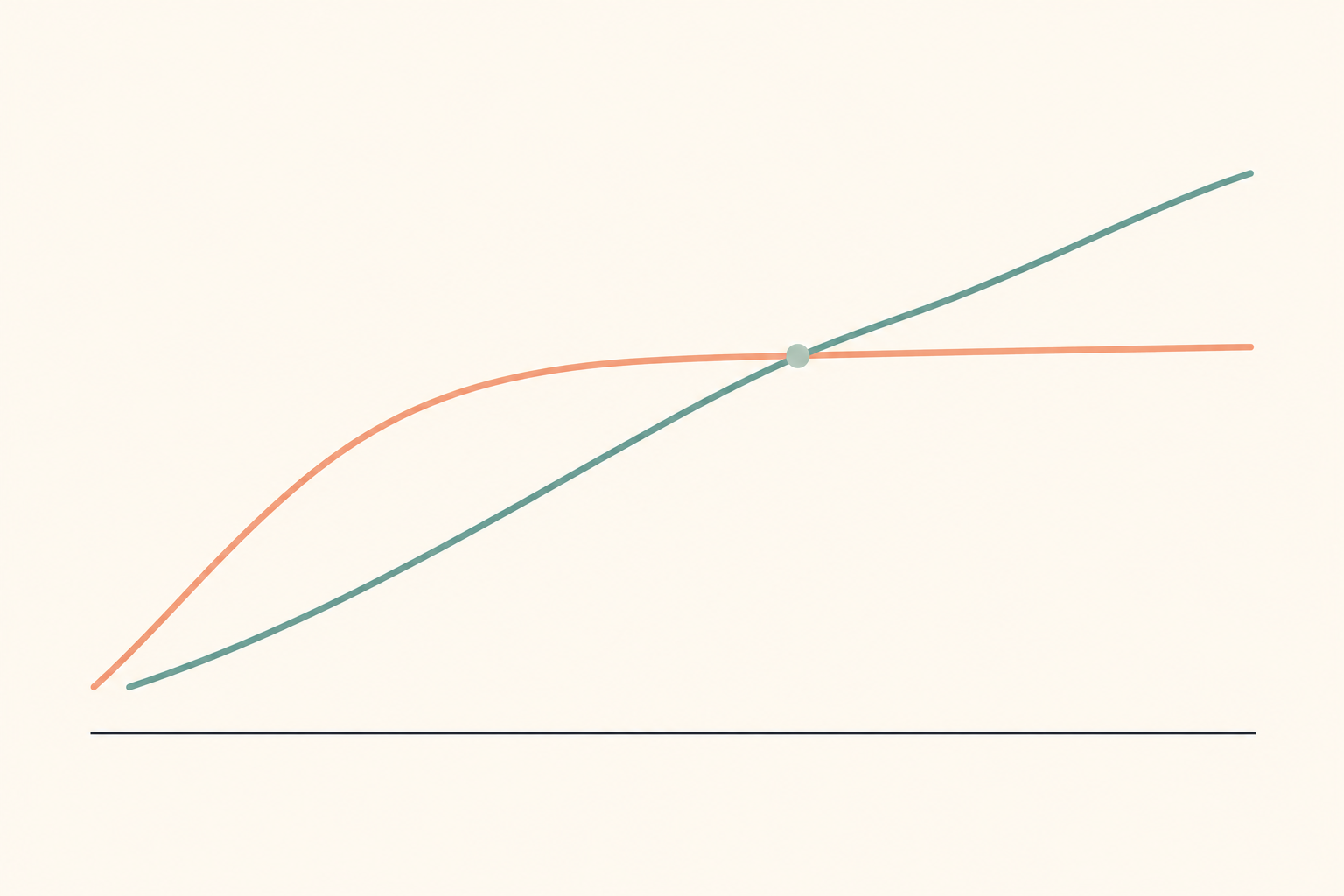
That arc is what makes the two positions on AI compatible. A technology can be badly overhyped relative to the value it is creating this quarter and badly underappreciated relative to what it will eventually do. Those aren't competing claims. They're claims about different points on the same curve.
Organizations across every sector are asking some version of that question right now, and associations are no exception. There have been a lot of projects launched, a lot of experiments run, and comparatively few results that leaders can hold up with confidence and say: here, this one worked, here's what it returned.
That question is worth taking seriously rather than treating it as resistance.
Consider the shape of the mismatch. The capital flowing into AI is staggering by any historical measure, and that spending does show up in the economy: AI-related investment has accounted for a striking share of recent US growth. What hasn't shown up yet is the productivity side. Individual studies and pilots document real gains at the task level, but those gains have not added up to a clear signal at the aggregate level. That gap is real, it's documented, and pretending otherwise damages your credibility with a board that reads the same coverage you do.
There are absolutely results out there. Associations are automating work that used to eat entire staff weeks, answering member questions at a speed they couldn't previously staff for, and producing content and analysis at volumes that would have required hiring. Those wins are real. They're also not yet at the scale the investment implies they should be.
Here's why the same technology can be underrated at the same moment it's being oversold.
Almost nobody has a clear picture of what organizational life looks like when intelligence becomes abundant and close to free. That includes the people building the technology. Our planning instincts are constructed around intelligence being scarce and expensive. You hire for it. You budget for it. You ration it across a staff of eleven people who all have more work than hours.
Take that constraint away and a surprising amount of what you currently treat as fixed about how your association operates stops being fixed. Which programs are viable. How many members one person can meaningfully serve. Whether research your organization has always wanted to publish is actually out of reach. Those are hard things to model in a three-year strategic plan, which is exactly why they tend to get left out of one.
Underestimation happens quietly. Overestimation makes headlines.
You've heard the term artificial general intelligence, usually shortened to AGI. It's the version of AI most people picture from movies, a system that can handle general purpose work the way a person can. What gets missed is that the definition has quietly changed, and the change itself tells you something.
The original framings placed AGI around the middle of the human capability curve. Not better than every lawyer, accountant, or nurse alive, but better than the average one. An earlier version set the bar lower still, at competent enough to actually hold the job. The definition gaining ground now is far more demanding: more capable than any human at essentially all economically valuable work. Both versions get used interchangeably in the same conversation, sometimes by the same person.
Here's a plausible reason the bar keeps rising. The value hasn't yet accrued to the economy, or to your association, at anything close to the level the investment suggested it should. If someone declares that general intelligence has arrived, the immediate and reasonable response is: then where are my results? Raising the bar defers that question.
The definitional argument and the ROI argument turn out to be the same argument wearing different clothes.
That framing also explains a gap worth understanding inside your own organization. On raw capability for work that doesn't require moving through physical space, the case that leading models perform at or above the level of an average professional is difficult to argue against at this point. The limitation is connection rather than capability. These systems aren't yet wired into the places your work actually happens: your AMS, your member records, your institutional knowledge, your approval workflows. Physical-world capability is a separate story entirely, and anything requiring a system to navigate real space and handle real objects sits well behind the knowledge work capability.
For association leaders, the practical version of all this comes down to a few habits:
The uncomfortable position, believing the technology is genuinely transformative while acknowledging the returns so far are thin, is a more accurate description of where things actually stand than either confident camp can offer. It's also a harder position to hold in a board meeting, which is probably why fewer people take it.
It tends to produce better decisions anyway.
1 min read
Timestamps:
1 min read
Associations have always worked hard to be a trusted source of content for their members and the industries they represent. Today, they’re...
1 min read
Summary: What if building a million-dollar business no longer required a team, funding rounds, or even technical expertise? In this episode of the...