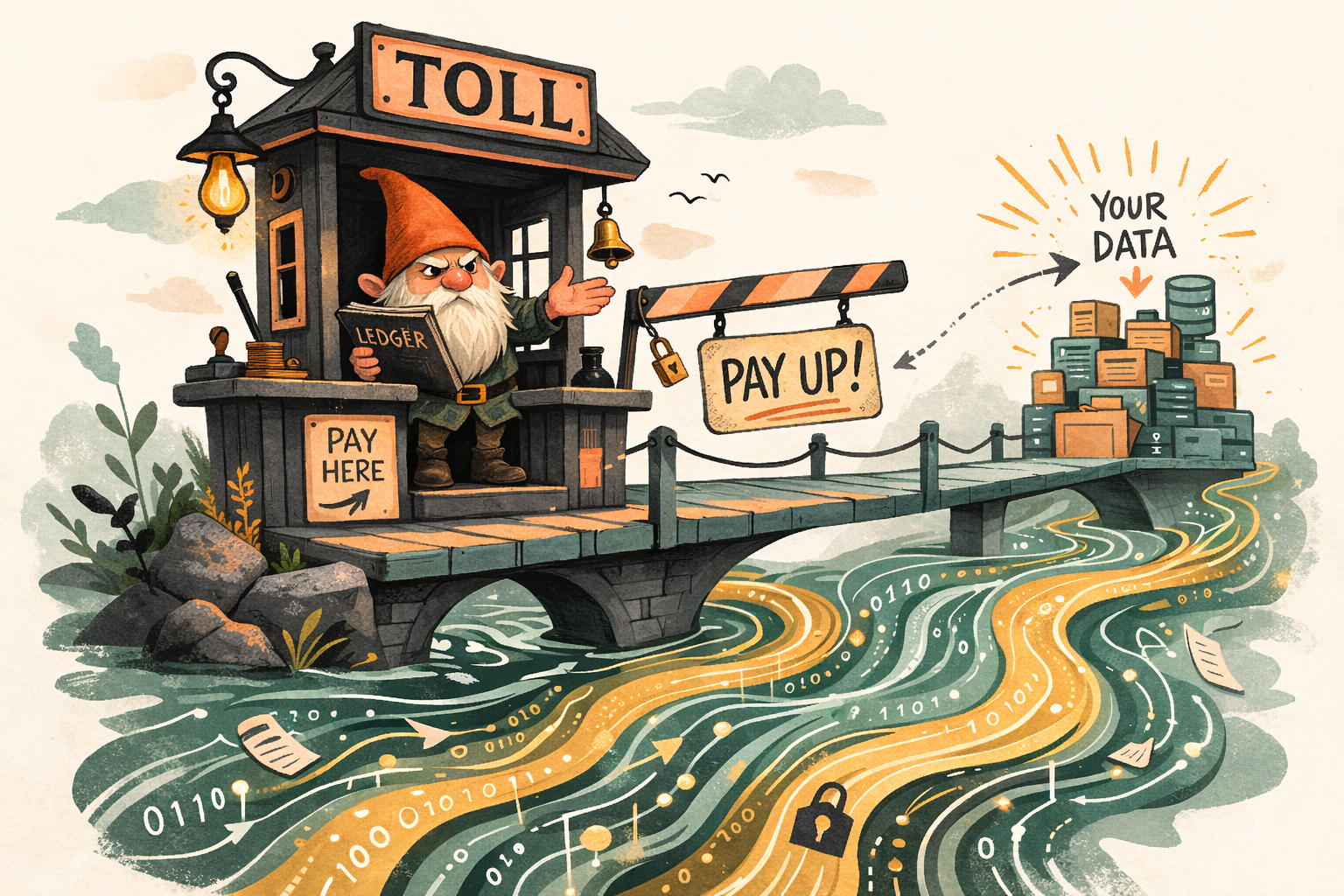
On a recent investor call, HubSpot CEO Yamini Rangan was asked how the company plans to respond to clients using AI agents to pull data out of HubSpot and analyze it elsewhere. Her answer was remarkably direct: "We will monitor it. We will meter it. And we will monetize it. Our platform is open by design, but we are not a free data pipeline for everybody to take that information out."
That's a pretty blunt warning from the CEO of a company known for being one of the most open platforms in the SaaS world. And it should get the attention of every association leader who relies on third-party software to manage members, track engagement, or run operations.
Because this isn't just about HubSpot. It's a signal of where the entire software industry may be headed — and associations that aren't paying attention to their data access rights could find themselves boxed in.
Why Software Companies Are Nervous Right Now
To understand why a statement like this is happening now, you have to look at what AI agents are doing to the software business model.
Since the start of 2025, investors have hammered the stocks of nearly every major software company. Salesforce, Snowflake, Workday, and others have seen share prices drop between 20 and 37 percent. The concern driving those declines is straightforward: AI agents can act as super users. They get work done faster and more efficiently than individual humans clicking through dashboards, which means organizations may need fewer user licenses over time.
That's a problem if your entire business model is built on per-seat pricing.
For two decades, SaaS companies have grown by adding more users at higher price points. AI agents threaten that model at its foundation. If one agent can do the work of five users, why would an organization keep paying for five seats?
Tollgating — charging for agent access to data — is one way software companies are looking to replace that lost revenue. And HubSpot's CEO just said the quiet part out loud.
What "Metering Your Data" Actually Means for Associations
Here's where this gets personal for associations.
For more than 20 years, software companies have allowed relatively free data exchange between applications through APIs. That openness is what makes integrations work. It's how your AMS talks to your email platform, how your CRM syncs with your event management system, and how your teams pull reports across tools without manually exporting spreadsheets.
Charging AI agents for data access would be a sharp reversal of that approach. And the concept feels, frankly, a little absurd. Think of it this way: it's like your bank charging you a fee every time you withdraw your own money. The data in your CRM — your member records, your engagement history, your pipeline — belongs to you. You generated it. You own it by contract and by law. But because you're a tenant in someone else's building, they get to set the terms for how you access it.
Now, there's a reasonable distinction here. If you're buying third-party data from a provider like ZoomInfo or Apollo.io, a metered model makes sense. You're purchasing someone else's data. But when a vendor starts metering access to your own first-party data — data your team created and maintains — that's a different conversation entirely.
Is This Really the Future — Or a Grasp at the Past?
Before anyone hits the panic button, it's worth stepping back and asking whether this approach actually has staying power.
There's a strong argument that metering data access is less of a forward-looking strategy and more of an attempt to hold onto a legacy revenue model. It's a bit like a newspaper responding to the rise of digital media by charging more for the print edition. It might generate short-term revenue, but it doesn't address the fundamental shift happening underneath.
Customer backlash and competitive pressure could easily force companies to walk this back. If one CRM locks down data access and a competitor keeps theirs open, businesses will notice. Switching costs are high in the short term, but they're not insurmountable — and resentment has a way of accelerating migrations that might not have happened otherwise.
That said, the fact that a company as well-regarded as HubSpot is saying this publicly on an investor call matters. It gives cover for others to follow. If HubSpot does it, why wouldn't your AMS vendor? Your LMS provider? Your event platform? It's a relatively easy way to shore up revenues in the short term, especially for companies facing pressure from investors who are nervous about the AI-driven disruption of SaaS.
The trend may not materialize exactly as described. But the conditions that are pushing companies in this direction — declining software valuations, AI agents reducing seat demand, pressure to show growth — aren't going away. The takeaway here isn't to panic. It's to prepare.
What Association Leaders Should Do Now
You don't need to overhaul your tech stack tomorrow. But there are a few things worth doing right now while you still have leverage.
- Audit your vendor contracts. Specifically, look at the terms around data access. Can you pull your data via API without restrictions? Is there a bulk export option? Are there any clauses that give the vendor the right to change data access terms unilaterally? If you don't know the answers, it's time to find out.
- Ask your vendors directly. This doesn't have to be confrontational. A simple question — "What are your plans around AI agent access and data metering?" — tells you a lot about where a vendor is headed. Their answer (or non-answer) will help you assess your risk.
- Don't wait for the policy change to react. The associations that will be in the strongest position are the ones who secure their data access before it becomes a negotiation point. Once a vendor announces new terms, your leverage drops significantly.
Why an AI Data Platform Is the Strongest Move You Can Make
Regardless of what any individual vendor decides to do, associations that control their own unified data will always have more options than those who don't.
This is where an AI data platform comes in. The concept is straightforward: bring your data from multiple systems — your AMS, LMS, CRM, financial tools, event platform — into a single environment that you own. Not a vendor's ecosystem. Not a platform that could change its terms on the next investor call. An environment where your data lives on your terms.
The important thing to understand is that this doesn't mean abandoning your current tools. You still use your AMS for what it does well. Your CRM still runs your sales and marketing workflows. Your LMS still delivers education. But your data — the raw information those systems generate — lives in a place where no vendor can gate it, meter it, or hold it hostage.
What's changed in the last few years is how accessible this has become. A data unification project that would have required seven figures and a year-plus timeline five years ago can now be set up in days or weeks, even for small associations. Open source platforms have dramatically lowered both the cost and the complexity, putting this kind of infrastructure within reach for organizations that never would have considered it before.
The best time to build this kind of foundation is before you need it. Waiting until a vendor announces new data access policies means you're reacting from a position of weakness. Getting ahead of it means you're operating from a position of choice.
Looking Ahead
This trend may not play out exactly the way HubSpot's CEO described. But the underlying shift is real. AI agents are changing how software gets used, and vendors are going to respond in ways that protect their revenue. Some of those responses will be innovative and genuinely valuable. Others will feel like toll booths on roads that used to be free.
Associations that take ownership of their data now — through an AI data platform, through smarter contracts, through a clear-eyed understanding of where their information lives — won't have to scramble when the rules change. They'll already be ahead.
March 3, 2026