Eighty percent of organizations surveyed in Anthropic's 2026 State of AI Agents Report say agents have already delivered measurable financial impact. The ROI debate, for most of these organizations, is effectively over. The technology works. Results are being reported.
So if that's where things stand, why are so many associations still stuck at the starting line?
The answer is in the same report. When organizations were asked what was blocking adoption, the barriers they named had almost nothing to do with the AI itself. They pointed to two problems that are entirely within an association's control to address — and that most organizations haven't fully reckoned with yet.
The First Problem: Your Data
Integration with existing systems was cited as the number one barrier to AI agent adoption, at 46%. Data access and quality came in third, at 42%. These aren't separate issues dressed up as two different findings. They're the same underlying problem showing up in two different places on the list.
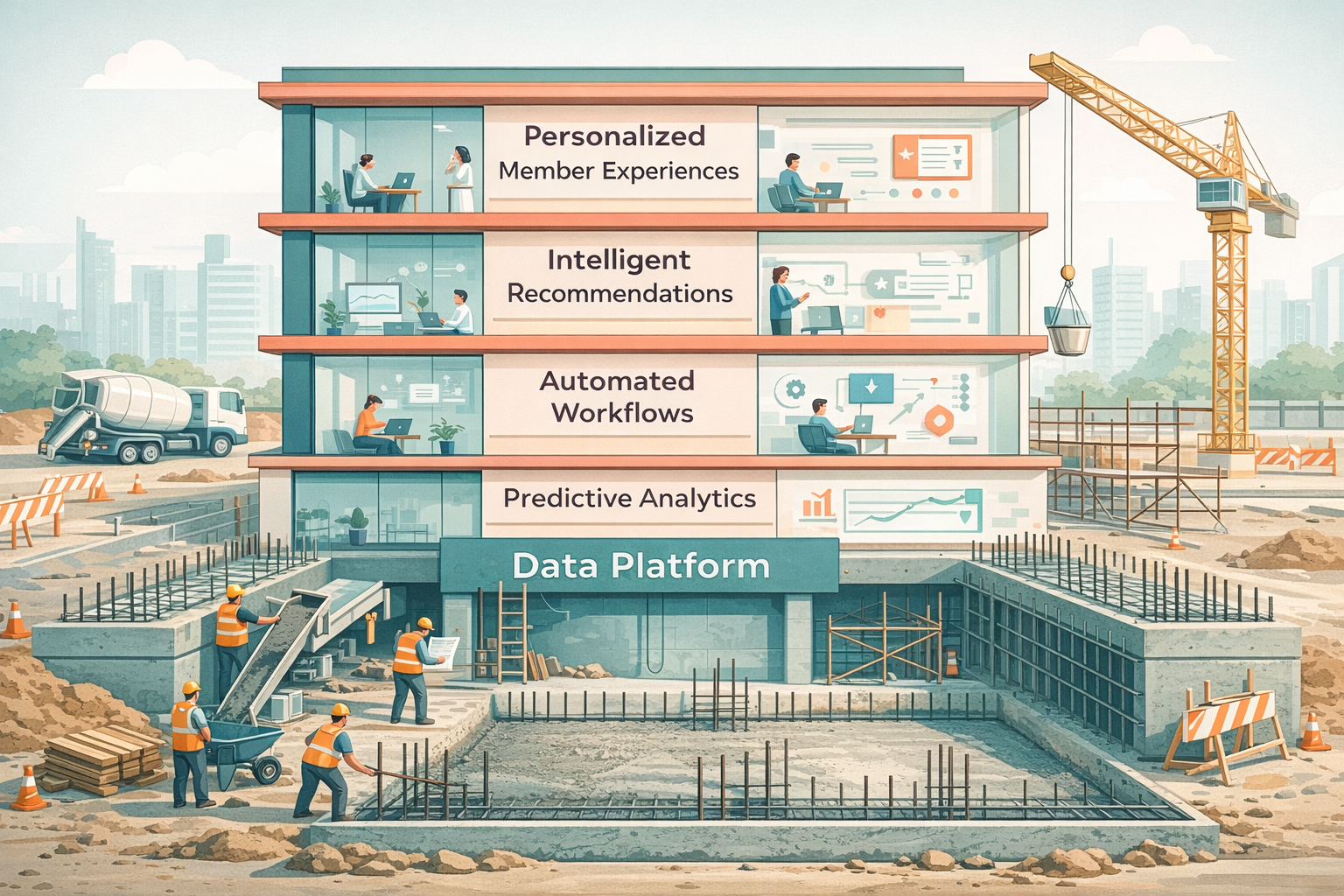
Agents can only work with what they can reach. If your member data lives across an AMS, an LMS, an events platform, and a finance system that don't talk to each other — and in many associations, it does — an agent built on top of that infrastructure is going to underperform. Not because the technology is limited, but because the foundation it's working from is fragmented.
Think of an AI agent like a new hire. A brilliant new hire who can't access the systems they need is going to struggle regardless of their capability. You wouldn't set someone up that way on their first week and then wonder why they weren't performing. The same logic holds for an agent.
There's a more specific version of this problem worth naming: building agents directly on top of your existing systems — your AMS, your CRM, your event platform — means building on infrastructure that is constantly changing. New integrations, updated fields, migration projects. Agents need a stable data layer to function reliably. A unified, consolidated place where your member data lives and can be consistently accessed is what makes everything else possible. For associations looking at this problem practically, MemberJunction — a free, open-source AI data platform that's part of the Blue Cypress family — is worth exploring as a foundation.
The practical first step here isn't a technology purchase. It's an audit. Where does your member data actually live? How many systems are holding pieces of it? If you needed to answer the question "how many members attended at least two events last year but haven't renewed," could you get that answer today — and how long would it take? That question alone will tell you a lot about your data infrastructure readiness.
The Second Problem: Your Culture
The employee resistance finding in the report is the one that tends to get glossed over — and it shouldn't, especially for associations.
For smaller organizations, 51% cited employee resistance as a barrier to AI agent adoption. For large enterprises, that number drops to 36%. Smaller organizations aren't more nimble when it comes to cultural change. In this particular area, they're more resistant.
That finding cuts against a comfortable assumption. The narrative around smaller organizations is usually that they're agile — fewer layers, faster decisions, less bureaucracy to move through. That may hold in some contexts. But when it comes to asking staff to fundamentally change how they work, size doesn't offer the protection it might seem to.
For associations specifically, this is worth sitting with. Many association teams have operated in relatively stable conditions for years — sometimes decades. The pressure to continuously adapt to new tools and new workflows has historically been lower than in other industries. That stability is genuinely valuable in many ways. But it also means that when significant change does arrive, the muscle for adapting to it may not be as developed as leadership assumes.
Resistance usually starts in the same place: people don't fully understand the technology, and what they don't understand feels threatening. That's not a character flaw — it's a reasonable response to genuine uncertainty. Even people who follow AI closely will tell you it's a moving target. A new model drops, a new capability emerges, something you thought you understood shifts. The uncertainty is real.
Which means the first line of defense isn't a policy. It's education. Investing in your staff's AI literacy — not a one-time training session, but ongoing, honest engagement with what this technology actually does and doesn't do — is what creates the conditions where agents can be adopted rather than resisted.
Beyond literacy, the conversation with your team has to include what's on the other side. When agents handle more of the routine work, where does that freed-up time actually go? The report has something useful to say here: the top answer from organizations that have implemented agents is learning new skills, followed by strategic and creative work, then relationship building with members.
New pathways are part of this conversation too. If you add an agent to your member services function, what does the evolved version of that role look like? Deeper member conversations. More capacity for the sensitive, nuanced interactions that have always deserved more time than staff could give them. An AI trainer role that didn't exist before. The associations that handle this well are the ones that name those possibilities explicitly — not as reassurances, but as real plans.
One final note on this, and it's a hard one: if there are people on your team who are fundamentally unwilling to adapt — not struggling, not uncertain, but unwilling — that's a different problem. Association leaders have a responsibility to do everything possible to bring their teams along. But the staff members who dig in hardest against change are often the ones who most need to make it. At some point, allowing that resistance to set the pace for the entire organization is its own leadership decision.
What to Do With This
The 2026 State of AI Agents Report is clear that almost no organization at the forefront of this space is opting out — only 3% of those surveyed said they plan to sit out agent adoption entirely. For associations, the question isn't whether to engage. It's what's actually in the way, and how to address it honestly.
If you're just getting started, begin with the data audit. Not because it's the most exciting thing on the list, but because everything else depends on it. Understand where your member data lives, how fragmented it is, and what it would take to bring it into a consolidated, accessible layer. That work pays off regardless of what you build on top of it.
If you're already experimenting, name your specific barrier. Is it integration? Data quality? Staff resistance in a particular department? Generic answers lead to generic solutions. The more precisely you can identify what's actually slowing you down, the more directly you can address it.
And if the change management conversation hasn't started yet — start it now. Not when you're about to deploy something. Not after a pilot is already running. The associations that will move fastest on this aren't the ones with the most sophisticated technology strategy. They're the ones whose teams are ready.
March 13, 2026