Associations are adopting AI at a pace that would have been hard to imagine even two years ago. Content generation, member service tools, internal automation, research workflows — the experimentation phase is well underway, and a growing number of organizations have moved past curiosity into genuine implementation.
But something frustrating is happening along the way. The tools are impressive. The models keep getting better. And yet, when associations try to apply AI to their actual operations — the messy, interconnected, data-dependent work that defines how an organization runs — the results often fall short. Not because the AI isn't capable, but because it can't see what it needs to see.
The culprit isn't the technology. It's the infrastructure underneath it. Specifically, it's organizational data scattered across so many disconnected systems that no AI tool can make sense of it all.
The Best Hire You've Never Onboarded
Here's a way to think about what's happening.
Imagine you've just hired the most talented, best-trained professional you could possibly find. They show up on day one ready to work. They're sharp, fast, and deeply knowledgeable. But when they sit down at their desk, there's nothing there. No access to your member database. No login to your CRM. No way into your event management system or your LMS. They can't see your financial records, your engagement data, or any of the spreadsheets your team relies on daily.
How effective would that person be? They could answer general questions. They could offer broad strategic advice. But they couldn't do the actual work of your organization because they have no connection to the information that makes that work possible.
That's the situation most associations are putting their AI tools in right now. Claude, ChatGPT, Gemini — these models are extraordinarily capable. But they're only as useful as the information they can access. And for most associations, that information lives in a dozen different places that don't talk to each other.
Your member data is in your AMS. Engagement metrics are in your email platform. Event history is in your event management system. Learning records are in your LMS. Financial data is in your accounting software. And then there are the spreadsheets — an unknowable number of them, maintained by different people across different departments, holding information that often exists nowhere else.
Each of those systems has its own data structure, its own access requirements, its own quirks. Asking an AI tool to connect to all of them individually is technically possible in some cases, but it's a governance headache, a security risk, and an integration project that most associations don't have the resources to maintain.
So instead, the AI gets access to whatever's easiest to hand over — usually a document or two, maybe a PDF export — and the results are predictably limited.
What an AI Data Platform Actually Does
There's a perception problem around data platforms that's worth addressing directly, because it's one of the main reasons adoption has been slower than it should be.
When association leaders hear "AI data platform," many of them picture something on the scale of an AMS migration. They think about the last time they switched a major system — the months of planning, the vendor selection process, the data migration headaches, the staff retraining, the things that broke along the way. And they understandably think: we can't take that on right now.
An AI data platform is not that.
In practical terms, an AI data platform is a cloud-based database that pulls data from your existing systems on a regular basis. That could be every few minutes or once a day, depending on what you need. The critical distinction is that it's read-only. You're not processing membership renewals through it. You're not signing people up for events or handling transactions. Your existing systems continue to do all of that, exactly as they do now.
What you're doing is creating neutral ground. A single location where data from across your organization — your AMS, CRM, LMS, email platform, event system, and yes, those spreadsheets — lives together under one set of security and access controls.
Once that layer exists, connecting AI tools becomes a fundamentally different proposition. Instead of wiring up AI to ten different systems with ten different authentication methods and ten different data structures, you connect it to one platform that already has everything consolidated. One connection point. One set of permissions. One governed access layer.
The practical lift involved is genuinely smaller than most people assume. You set up a cloud database. You configure data pipelines from your existing systems. You authenticate. And you're connected. It's more like adding a new utility to your tech stack than overhauling your infrastructure.
Why This Has Been Slow to Catch On
If the lift is manageable, why haven't more associations done it?
Part of the answer is cultural. Associations tend to move deliberately, and that's not unique to them. Any organization with multiple stakeholders, legacy systems, and governance requirements tends to approach new technology cautiously. There's always another urgent priority competing for attention, and something that sounds like a backend infrastructure project rarely wins that competition — even when it probably should.
Part of the answer is the legacy systems themselves. Many associations run on older, heavily customized platforms that weren't designed to share data easily. These systems process the business of the association and generally work well enough for their intended purpose, but they create real friction when you try to integrate them with anything modern. That friction adds up, and it's discouraging enough that a lot of organizations decide to defer the effort.
And part of the answer is a reasonable concern about data security. Association leaders are rightly protective of their member data, and the idea of pulling it all into a new location raises legitimate questions about governance, access control, and risk.
Here's the irony: an AI data platform actually addresses that security concern more effectively than the current state of affairs. Right now, if you're connecting AI tools to individual systems, each connection has its own security posture, its own access controls, its own potential vulnerabilities. A unified data platform gives you a single, governed access point where you can set permissions once and enforce them consistently. It's more secure than the alternative, not less.
The good news is that adoption has been picking up. It's still slower than the pace of AI advancement would suggest it should be, but the momentum is building as more organizations realize that this is the step that unlocks everything else.
More Urgent Than Your Next AMS Upgrade
Here's where it's worth being direct.
If your association is evaluating whether to replace your AMS or invest in an AI data platform, the data platform will almost certainly deliver more strategic value. Replacing your AMS with a newer AMS still gives you an AMS. It might be a better one — a cleaner interface, some improved features, maybe a more modern architecture. But it's fundamentally the same category of tool doing fundamentally the same job.
A data platform unlocks an entirely new category of capability. It's the difference between using AI for isolated tasks — drafting an email here, summarizing a document there — and using AI as an operational layer across your entire organization.
Consider what's happening in the broader AI landscape right now. Major platforms like Anthropic's Cowork are releasing vertical plugins that connect to external data sources through MCP servers. Open-source models are making powerful AI accessible at a fraction of the cost they were a year ago. Agent architectures are emerging that can break complex tasks into pieces and coordinate sub-agents to work on them simultaneously. All of these developments are exciting, and all of them converge on the same requirement: access to your data.
If your data is unified in a modern platform with built-in AI connectivity — including MCP server capabilities — your team members can connect tools like Cowork in a matter of clicks. That's not a theoretical future. That's available right now. But if your data is still siloed across disconnected systems, each of those advancements remains frustratingly out of reach.
The associations that will pull ahead aren't necessarily the ones with the biggest technology budgets. They're the ones that get their data into a position where AI can actually work with it. That's the differentiator. Not which chatbot you're using. Not which model you've subscribed to. Whether your AI tools can see and reason over the information that matters to your organization.
The Unglamorous Work That Changes Everything
There's no getting around the fact that AI data platform implementation lacks the excitement of a new AI tool demo. Nobody's going to tweet about their data pipeline configuration. It may not make for a great conference keynote.
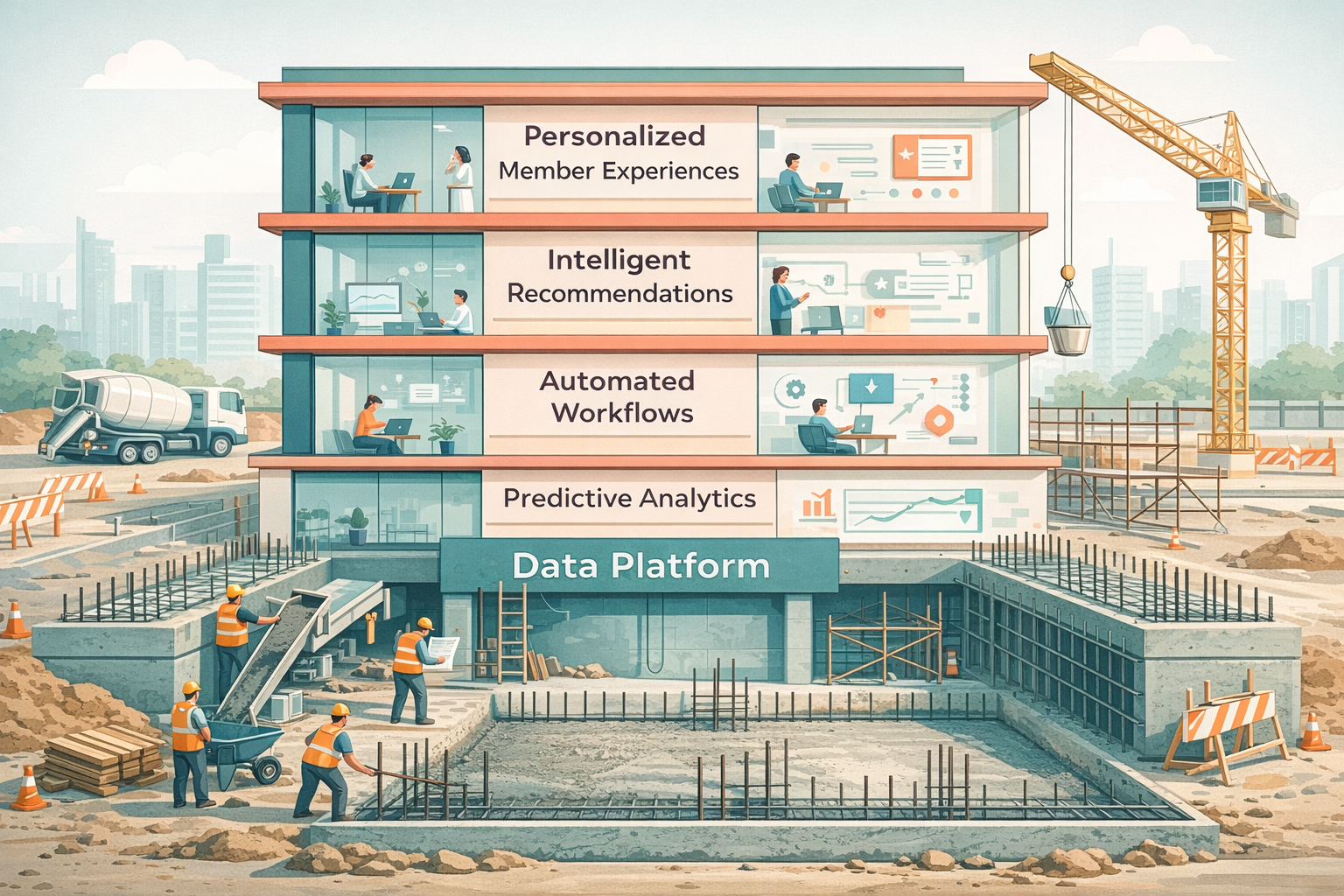
But it's the work that separates organizations experimenting with AI from organizations actually transformed by it. Every compelling AI use case you've seen — personalized member experiences, intelligent event recommendations, automated onboarding workflows, proactive member retention — depends on AI having access to comprehensive, current, well-organized data. Without that foundation, even the most powerful model in the world is guessing.
The encouraging reality is that this work is more accessible and less disruptive than most association leaders expect. You're not ripping out existing systems. You're not changing how your team does their daily work. You're adding a layer underneath that makes everything else smarter.
And once it's in place, the return on that investment compounds. Every new AI tool that launches, every new capability that emerges, every new plugin or agent architecture that becomes available — they all become immediately more useful because they can connect to your data from day one.
The harder part isn't the technical implementation. It's the decision to prioritize it. To look at a list of competing projects and say: this is the one that makes all the others more valuable. That's the infrastructure gap. And closing it is the most important AI investment most associations can make right now.
February 12, 2026