1 min read
The Infrastructure Gap Holding Your AI Strategy Back
Associations are adopting AI at a pace that would have been hard to imagine even two years ago. Content generation, member service tools, internal...

5 min read
Sidecar Team : July 15, 2026
For years, the standard advice for association executives has been: "Clean your data first." It sounds responsible. It feels like the right thing to do. It is also the primary reason most artificial intelligence initiatives never get off the ground. The prevailing wisdom suggests that before you can even think about using AI, you must embark on a multi-year journey to scrub every record in your Association Management System (AMS), map every field in your Learning Management System (LMS), and ensure your CRM is a pristine temple of structured information. This belief is not just exhausting; it is increasingly incorrect.
The reality is that if you wait until your data is perfect to start your AI journey, you will never start. Data is inherently messy because it reflects human activity, which is also messy. Members change jobs, use different email addresses for different events, and leave half-finished profiles in various systems. In the past, this messiness was a barrier. Today, thanks to modern AI data platforms and advanced reasoning models, it is simply a starting point. You do not need to get your data "dressed up" for AI. You can come as you are.
To understand why the "clean it first" mandate is dying, we have to look at the traditional way organizations tried to unify their information. This process is known as ETL: Extract, Transform, Load. For decades, this was the only way to get data from different systems to talk to each other. You would extract data from your AMS, transform it into a new format that matched your other systems, and then load it into a central warehouse.
The first and last steps—extracting and loading—are relatively straightforward. The middle step, transformation, is where the pain lives. Transformation requires a human, or a team of humans, to manually decide how a "member" in one system matches a "contact" in another. It involves writing complex rules to handle every possible discrepancy. This work is fragile and high-maintenance. If a vendor updates their software or you add a new field to your database, the entire transformation logic often breaks.
Beyond being fragile, ETL is expensive. It requires specialized data scientists or consultants to spend months mapping fields. Perhaps most importantly, the transformation process often results in a loss of resolution. To make data from different systems fit into a single, rigid structure, you often have to compress it or throw away the "messy" parts that do not fit. You end up with a summary of your data rather than the full, rich picture. In an era where AI thrives on detail, this compression is a strategic disadvantage. Modern data management is moving away from this rigid model because AI is now smart enough to handle the "transform" step on its own.
One of the most significant shifts in technology is the ability of AI to reason across unstructured data. In the old world of data management, if information did not sit neatly in a row or a column, it was essentially invisible to your software. This includes the vast majority of what your association actually holds: emails, community forum posts, webinar transcripts, and even the "comments" fields in your database where staff members often stash the most important details about a member's preferences.
AI flips this dynamic. Through a mechanism called vectors, AI converts text, audio, and images into strings of numbers that capture the underlying meaning of the content. This is not keyword matching; it is meaning search. When you use an AI data platform, the system does not need you to tell it that a member's email about a "certification problem" is related to the "LMS technical issues" category in your spreadsheet. It understands the relationship because it understands the language.
This means the unstructured data you have been ignoring—what some call "data exhaust"—is suddenly your most valuable asset. Your email history with a member contains more insight into their satisfaction and personality than any structured "member type" field ever could. When you stop obsessing over cleaning and start focusing on unifying, you allow AI to look at all of this raw information. It can read through ten years of email chains and infer whether a member prefers punchy, short updates or long, detailed reports. It can see a post in an online community and suggest a relevant session at your next annual meeting. None of this requires a pre-cleaned database; it only requires access to the data as it currently exists.
Perhaps the most common reason association leaders cite for delayed AI adoption is the "duplicate problem." We have all seen it: a single member who somehow has eight different records across four different systems. One record has their work email, another has their personal Gmail, a third has a misspelled last name, and a fourth is tied to a job they left five years ago. Traditionally, fixing this required a massive manual effort to de-duplicate and merge records before any analysis could happen.
Modern AI tools have turned this into a task for an "agentic data scientist." Instead of a human spending weeks comparing spreadsheets, you can now deploy an AI agent that works within your data platform to identify these overlaps. These agents use reasoning models to look at the signals across your systems. They can determine with high probability that "Jane D." in the event registration system is the same person as "J. Doe" in the LMS, even if the data fields do not match perfectly.
This automation extends to data mapping as well. When you bring your data into a unified platform, AI can generate its own data dictionary. It looks at the raw tables from your various vendors and creates its own definitions for what each field means. It recognizes that "Cust_ID" in one system and "Member_Number" in another are functionally the same thing. This removes the need for the months of manual mapping that defined the ETL era. By automating the detection of duplicates and the mapping of disparate fields, AI allows you to move from a fragmented view of your membership to a unified one in a fraction of the time. What used to take a year of professional services can now often be accomplished in a few weeks of automated processing.
When you stop waiting for perfect data, the goal of your data strategy shifts. It is no longer about storage; it is about activation. Data at rest is a liability—it costs money to store, it poses a security risk, and it provides zero value. Data activated through an AI data platform becomes a strategic asset that works for you in real time.
Once your data is unified—even if it is still "messy" by traditional standards—you can begin to use predictive AI. You do not need a PhD-level data science team to build these models anymore. For example, you might want to predict which long-time attendees are at risk of skipping your next conference. An AI agent can spend hours or days testing different models against your raw data, identifying the subtle signals that precede a member's decision to disengage.
This activation also protects you from vendor lock-in. Many software vendors are beginning to gatekeep access to your data, charging "tollgates" for AI agents to reach the information you technically own. By consolidating your data into a platform you control—such as an open-source AI data platform—you ensure that you have the freedom to use whatever AI tools you choose. You are no longer dependent on your AMS or CRM vendor's specific AI roadmap. You can see the full picture of a member's journey across every touchpoint, from their first email to their most recent certification, all in one place.
The transition from a "clean first" mindset to a "unify first" mindset changes the timeline of digital transformation. A traditional data cleaning and warehouse project is often a multi-year endeavor that many associations never finish. A unification project, by contrast, is a matter of weeks.
The realistic first step is to pick three to five of your most critical systems—perhaps your AMS, LMS, and your primary email tool. Instead of trying to fix the data inside those systems, you replicate it exactly as it is into a unified environment. This "come as you are" approach allows you to see your data unified for the first time, which almost always surfaces possibilities you did not know existed.
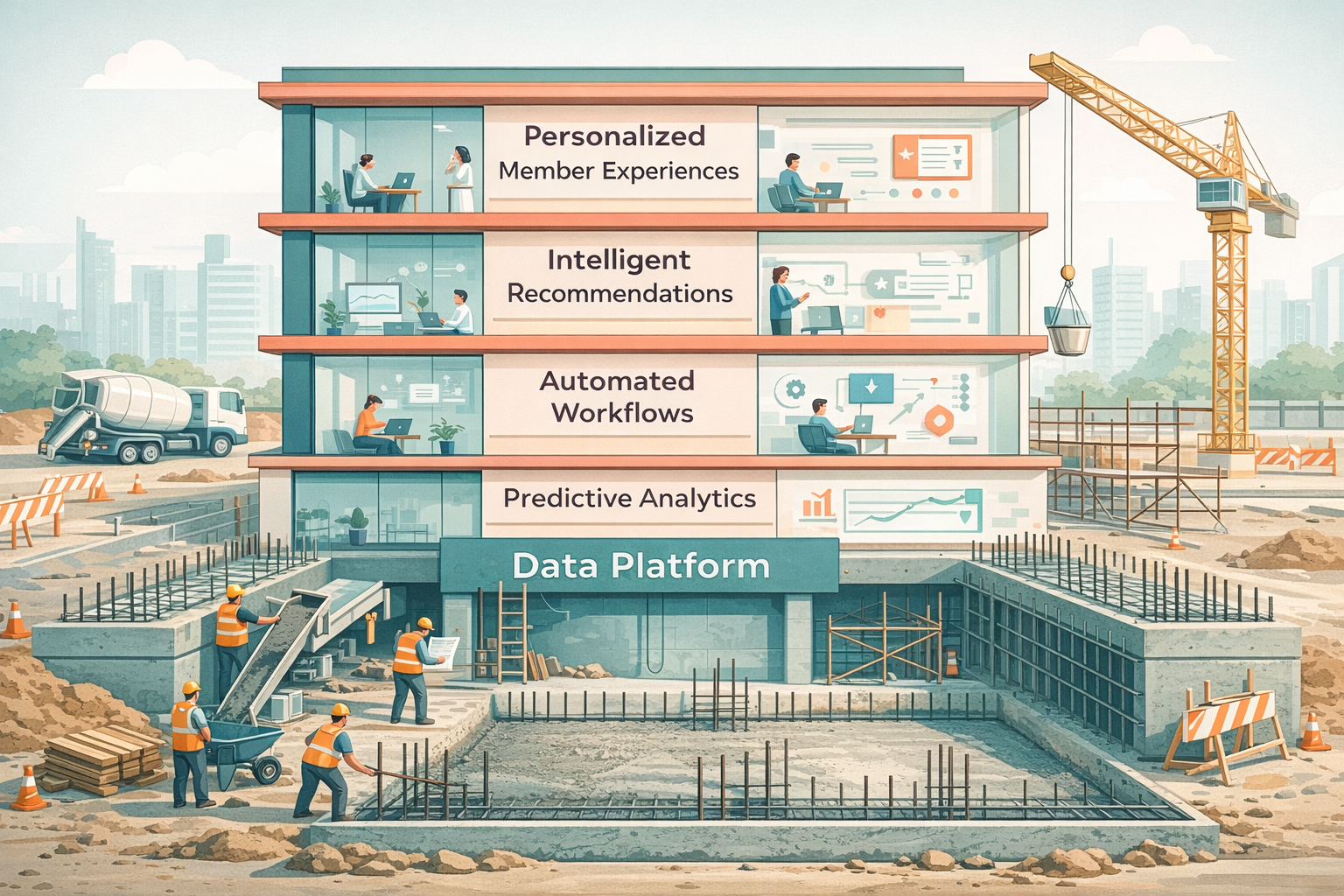
You will likely be shocked at the state of your data when you first see it all in one place. That is a good thing. Seeing the duplicates, the missing fields, and the inconsistent records is the first step toward actually solving those problems using the power tools AI provides. You are no longer trying to dig a canal with a hand shovel; you are using a laser-guided excavator. The tools to clean, map, and predict are already built into the platform. Your only job is to give them something to work with. Stop waiting for a perfection that will never come and start building the foundation your association needs to thrive in the age of AI.
1 min read
Associations are adopting AI at a pace that would have been hard to imagine even two years ago. Content generation, member service tools, internal...
1 min read
When association leaders hear the term "AI data platform," there's usually a familiar response: "Oh, so it's like a data warehouse?" Not quite.
1 min read
Imagine you want to answer a seemingly simple question about your association's membership: Are there geographic trends in your year-over-year...