Most association professionals have a working mental model for AI at this point. You give it a task, it works through it, and it gives you something back. Maybe it drafts a member email, summarizes a report, or helps you brainstorm event themes. It's one AI, one task, one output.
That model is already outdated.
A recent release from Moonshot AI, a Chinese company founded in 2023, introduced Kimi K2.5 — an open-source model that can do something fundamentally different. Instead of working through a complex problem step by step, Kimi K2.5 can analyze a task, break it into pieces, and spawn up to 100 specialized sub-agents that work on those pieces simultaneously. These sub-agents aren't pre-programmed roles. The model creates them on the fly based on what the task requires.
It's called an agent swarm, and it represents a meaningful shift in how AI systems approach complex work.
AI That Delegates
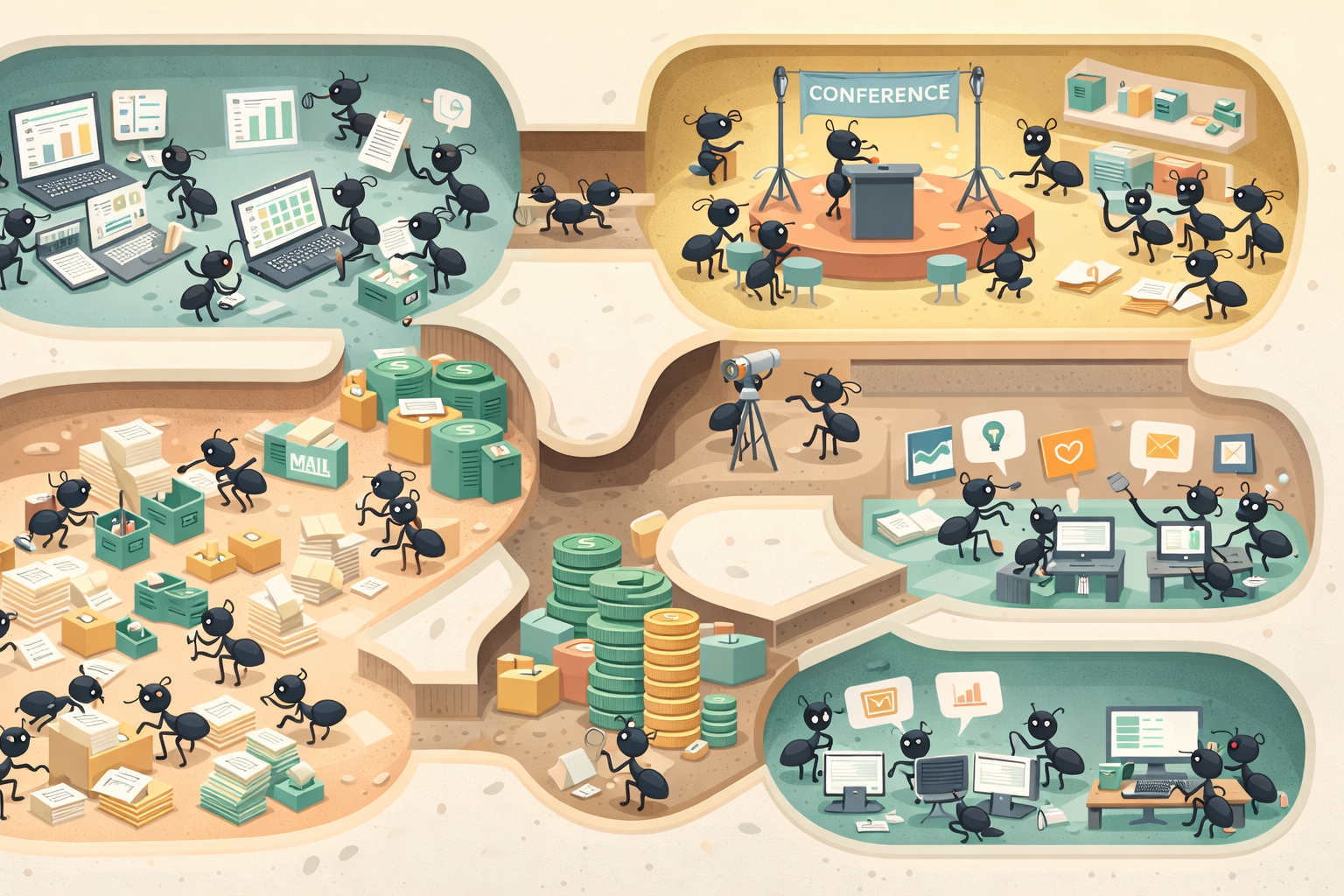
Here's the simplest way to think about it. Imagine you're planning your association's annual conference. There are dozens of parallel workstreams — venue research, speaker outreach, sponsor communications, budgeting, marketing timelines, registration logistics. No single person handles all of that alone. You break the work into pieces and assign it to people with the right skills for each part.
Agent swarms work on the same principle. A lead agent looks at a complex request, determines what sub-tasks are needed, creates specialized agents for each one, and runs them in parallel. When the sub-agents finish their work, the lead agent pulls everything together into a cohesive output.
Moonshot AI claims this approach cuts execution time by up to 4.5x for complex workflows. That tracks logically — doing ten things at once is faster than doing ten things in sequence.
Now, the concept of sub-agents isn't entirely new. Tools like Claude Code have been spawning sub-tasks for a while, and Google's deep research mode works the same way — it sends out multiple agents to research different facets of your question and then synthesizes the results. Even some open-source platforms use this pattern in their research agents.
But there's an important distinction. In those existing tools, developers pre-designed the paths. Someone building the system decided in advance what kinds of sub-tasks the AI should be able to create and under what circumstances. What Kimi K2.5 does differently is generalize this capability at the model level. The model itself decides what sub-agents to spin up, what roles they should play, and how to divide the work — without being told. It's the difference between AI following a recipe and AI writing its own recipe based on what's in the kitchen.
Seeing Is Understanding
Kimi K2.5 is also multimodal from the ground up, trained on 15 trillion tokens that mix text and visual data together. In practical terms, this means you can provide images or video alongside text instructions, and the model reasons across all of it simultaneously.
In a demo from Moonshot AI's founder, someone uploaded a screen recording of a website, and Kimi K2.5 recreated the interface in clean, working code. That's a compelling demo, but it's worth being honest about what that actually means in practice. Can an association leader record a website they admire and get a replica built at the snap of their fingers? Not quite. The capability is real, but context, refinement, and technical understanding are still part of the equation. A raw output from any AI model — no matter how impressive — needs human judgment to become production-ready.
Where multimodal input gets genuinely powerful is in giving AI a richer understanding of the problem you're trying to solve. If you're working with an AI coding tool and something looks wrong on screen, providing a screenshot alongside your description makes the AI dramatically more effective at finding the issue. The same principle applies to any kind of work. The more context you can provide — in whatever format — the better the output.
Kimi K2.5 outputs text (it's not an image generator), but its ability to take in and reason over images and video makes it a stronger collaborator. And this matters beyond just coding. As AI models become more fluent with visual input, they get better at computer automation — the process of navigating software interfaces the way a human would, by looking at the screen, deciding what to click, and taking action. That capability is still slow compared to how quickly you or I can navigate a website, but it's improving fast. And for tasks you can hand off and walk away from, speed matters less than the fact that it got done without your involvement.
More Choice, Lower Cost
Kimi K2.5 is part of a wave worth paying attention to. Over the past year, a series of powerful open-source have emerged from Chinese companies — DeepSeek, GLM from Zhipu AI, the Qwen series from Alibaba, and now Kimi K2.5 from Moonshot AI. These models are free to use, modify, and build on, and they're performing at or near the level of US frontier models.
The cost difference is significant. Kimi K2.5's API access runs about 60 cents per million input tokens and roughly $2.50 per million output tokens — substantially cheaper than comparable US models. Moonshot's pitch is straightforward: we match or beat your performance, and we cost a fraction of the price.
For associations evaluating whether to build custom AI solutions, this trend matters. The cost barrier for serious AI work keeps dropping. Models that would have been out of reach financially a year ago are now accessible to organizations with modest technology budgets.
But a necessary caveat: where your AI model runs matters. Open source doesn't mean zero risk. Depending on the sensitivity of the data you're working with, you need to think carefully about which inference providers host the model and where your data is being processed. Kimi K2.5 is available through several US-based inference providers, but you should verify data handling practices before feeding it anything sensitive.
What This Means for Your Organization
You don't need to implement agent swarms tomorrow. But understanding where AI capability is headed helps you make better decisions about where to invest your time and resources today.
Here's the trajectory: AI is moving from assistant to coordinator. From a tool that helps with individual tasks to a system that can manage complex, multi-step workflows with minimal human direction. Agent swarms are an early but meaningful step in that direction.
The associations that will benefit most from this shift are the ones already building the right foundation. That means clean, accessible data. It means well-documented workflows that could eventually be handed to an AI coordinator. And it means a culture that's willing to experiment, test, and iterate rather than waiting for perfect solutions.
A practical next step: identify one complex, multi-step process in your organization that currently requires coordination across multiple people or systems. Maybe it's your new member onboarding workflow, your event planning pipeline, or your content production process. Map it out. Understand the dependencies. That's the kind of task that agent swarms will eventually handle end to end — and the organizations that have already mapped and documented those workflows will be first in line to benefit.
The competitive landscape for AI models is expanding fast, with more powerful and affordable options arriving regularly. Staying informed on these developments helps you make smarter, more confident decisions about when and how AI fits into your strategy. You don't need to chase every new release. But you do need to understand the direction things are moving so you're not caught off guard when the capabilities catch up to the complexity of your work.
February 10, 2026