24 min read

Live From digitalNow 2026: Why AI Is an Appreciating Asset | [Sidecar Sync Episode 159]

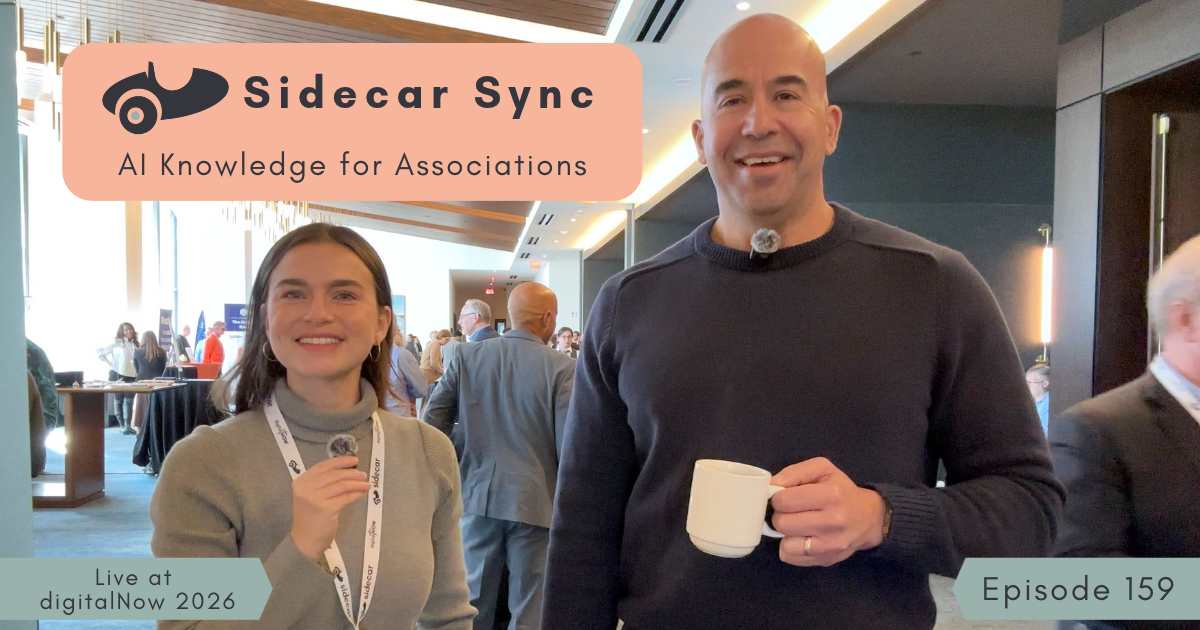
Episode 159 of the Sidecar Sync Podcast cover art featuring Amith Nagarajan and Mallory Mejias

Summary:

The most useful ideas at digitalNow 2026 came from association leaders describing what they've actually built. Recorded on location in Arlington, Virginia, this conference edition finds Amith Nagarajan and Mallory Mejias swapping the studio for the event floor, with plenty for association leaders who couldn't make the trip. Amith unpacks his Sovereign AI keynote: own your data, rent the intelligence, and control the leverage. Mallory then talks with George Breeden of the American Society for Microbiology about enterprise Copilot and MemberJunction, with Dean Patterson and Pedro of the Center for Emerging Global Leaders about screening 300 applicants through AI interviews, and with Blue Cypress's Sofi Giglio about bringing boards along, separating run from drive, and treating AI as an appreciating asset. Mallory closes with a recap of her own keynote on auditioning for relevance in members' lives.

Timestamps:

00:00 - Live From digitalNow 2026
03:44 - AI Inside Your Existing Stack with George Breeden
09:30 - Leveling the Applicant Field with Dean & Pedro
16:56 - Leading with Strategy, Not AI with Sofi Giglio
24:36 - Wrapping Up: Auditioning for Relevance


👥Provide comprehensive AI education for your team

https://learn.sidecar.ai/teams

 🤖 Join the AI Mastermind:

https://sidecar.ai/association-ai-mastermind 

🎀 Use code AIPOD50 for $50 off your Association AI Professional (AAiP) certification

https://learn.sidecar.ai/

📕 Download ‘Ascend 3rd Edition: Unlocking the Power of AI for Associations’ for FREE

https://sidecar.ai/ai

 📅 Join the pre-registration list for digitalNow 2027:

https://sidecar.ai/digitalnow 

🛠 AI Tools and Resources Mentioned in This Episode:

CEGL ➔ https://www.global-leaders.org

Claude ➔ https://claude.ai

OpenAI ➔ https://openai.com

Gemini ➔ https://gemini.google.com

Microsoft 365 Copilot ➔ https://www.microsoft.com/en-us/microsoft-365/copilot

MemberJunction ➔ https://memberjunction.org

rasa.io ➔ https://rasa.io

👍Please Like & Subscribe!

https://www.linkedin.com/company/sidecar-global

https://twitter.com/sidecarglobal

https://www.youtube.com/@SidecarSync

Follow Sidecar on LinkedIn

⚙️ Other Resources from Sidecar: 

More about Your Hosts:

Amith Nagarajan is the Chairman of Blue Cypress 🔗 https://BlueCypress.io, a family of purpose-driven companies and proud practitioners of Conscious Capitalism. The Blue Cypress companies focus on helping associations, non-profits, and other purpose-driven organizations achieve long-term success. Amith is also an active early-stage investor in B2B SaaS companies. He’s had the good fortune of nearly three decades of success as an entrepreneur and enjoys helping others in their journey.

📣 Follow Amith on LinkedIn:
https://linkedin.com/amithnagarajan

Mallory Mejias is passionate about creating opportunities for association professionals to learn, grow, and better serve their members using artificial intelligence. She enjoys blending creativity and innovation to produce fresh, meaningful content for the association space.

📣 Follow Mallory on Linkedin:
https://linkedin.com/mallorymejias

Read the Transcript

🤖 Please note this transcript was generated using (you guessed it) AI, so please excuse any errors 🤖

[00:00:00:00 - 00:00:01:11]
 (Upbeat Music)

[00:00:01:11 - 00:00:10:01]
Amith
 Welcome to the Sidecar Sync podcast, your home for all things innovation, artificial intelligence and associations.

[00:00:11:10 - 00:00:12:23]
 (Upbeat Music)

[00:00:14:15 - 00:00:19:13]
Amith
 Hey everybody, welcome to the Sidecar Sync. We are on location today, Mallory. What do you think?

[00:00:19:13 - 00:00:34:20]
Mallory
 I am having a blast. We are live onsite at digitalNow 2026. If you're on YouTube, you can see all of the people behind us. We're on break right now. We just had two fabulous keynote sessions. Amith was first, and then we just had Kipp Bodnar from HubSpot. Amith, how are you doing?

[00:00:34:20 - 00:00:51:16]
Amith
 I'm doing great. It's been fun so far. We have record attendance here at DigitalNow, and I think it's, everyone seems to be having a good time. Washington DC is beautiful right now. It's the time of the year, and I'm just excited to have so much energy in the room. There's a lot of people here that are really pumped about AI and associations and

[00:00:52:24 - 00:00:54:00]
Amith
 figuring out what's next.

[00:00:54:00 - 00:00:59:17]
Mallory
 Absolutely. Also, we're at a beautiful hotel, Hilton. What is the Hilton Key, the Roslyn?

[00:00:59:17 - 00:01:00:23]
Amith
 Yeah, Hilton, the Key.

[00:01:00:23 - 00:01:02:00]
Mallory
 Hilton, the Key.

[00:01:02:00 - 00:01:05:21]
Amith
 Roslyn in Arlington, Virginia, just across the river from Georgetown.

[00:01:05:21 - 00:01:15:21]
Mallory
 Yeah, beautiful venue. Amit, I don't wanna give too much away from your keynote this morning, but the whole concept was an idea called Sovereign. Can you explain to our listeners a little bit about what that means?

[00:01:15:21 - 00:02:25:05]
Amith
 So, Sovereign AI is the idea of ultimately having control, and my main point was that associations have to make intentional choices, that you can either kind of take the easy route, which is to say, "Hey, I'm just gonna pick one vendor, "and it's gonna be Claude, "or it's gonna be OpenAI, or maybe Gemini," and then take your data over there, build your infrastructure there, and there's advantages to it, right? I mean, because it's not easy, but it's easier to say, "Hey, I'm just gonna bet on Anthroppit. "I'm gonna bet on Google, whichever one you want." The challenge to that is you ultimately then lose optionality. And so what I'm arguing for is that, associations need to do three things well. First, they have to own their data. Second, they have to rent the intelligence rather than trying to buy it. And what I mean by that is have optionality, where you can bring in Gemini for certain things, bring in Anthroppit for other things. And then finally, what I described as controlling the leverage is the third point, and that's about using AI where it makes sense. You know, on the pod normally, we talk about all these places where you can use AI, but should you? Does it make sense? You could use other tools. So that was the essence of my talk. So you don't mean to watch the keynote anymore. Exactly.

[00:02:25:05 - 00:02:35:20]
Mallory
 That was just, it was basically pretty easy. We got all the key points. Amit, is there anything that you're most excited for over the next few days, whether it's the download party we have, maybe a certain keynote speaker, what are you most looking forward to?

[00:02:35:20 - 00:03:00:24]
Amith
 Well, I think Erick O'Neill's keynote this afternoon, where he's gonna be talking about all of his interesting experiences in life will be fascinating. I also think cybersecurity, it's something if you aren't thinking about it, folks, you gotta be spending some time thinking through cybersecurity and really buttoning up your organization. It's such a critical part. So I'm excited that we brought Erick here. I had a chance to watch "Reach" recently. Have you seen the movie?

[00:03:00:24 - 00:03:03:12]
Mallory
 I haven't seen it. But I should have done that before doing this.

[00:03:03:12 - 00:03:16:01]
Amith
 It was part of my prep for this traditional now. Okay, I see, I see. Yeah, so I read the book and then I watched the movie. And I think the movie was really good. It was interesting. So no spoilers, but well, I guess also, he does catch the guy.

[00:03:16:01 - 00:03:29:15]
Mallory
 Yeah, he did say it on our podcast. And to be fair, he did really catch the guy. He's here at Digital Now. He'll be speaking the last keynote of today. And then I am moderating a panel with you and Erick on it, which I'm super excited about. Obviously I interview you every week on the pod.

[00:03:29:15 - 00:03:31:17]
Amith
 I'm glad you reminded me, because I might not have shown up for it.

[00:03:31:17 - 00:03:39:17]
Mallory
 Oh, people are pleased. All right, well, hopefully a meese shows up. Maybe it'll just be Erick and I, but we will keep you all in the loop over the next few days at Digital Now and let you know what to expect.

[00:03:39:17 - 00:03:43:05]
Amith
 Yeah, well, we're excited to be here. It's gonna be great.

[00:03:44:18 - 00:03:54:00]
Mallory
 All right, everyone, we are on day two of Digital Now. And I am joined by the lovely George Breeden. George, can you introduce yourself to our audience and tell us what organization you're coming from?

[00:03:54:00 - 00:04:00:23]
George
 Sure, I'm George Breeden with the American Society for Microbiology, and I'm their Chief Learning Innovation Officer.

[00:04:00:23 - 00:04:08:13]
Mallory
 Wow, and what brings you to Digital Now, 2026? Did you come to this event looking for something special, just hoping to be inspired?

[00:04:08:13 - 00:04:10:12]
George
 Yeah, a little of all of that.

[00:04:11:16 - 00:04:19:08]
George
 This is a great opportunity to talk to other association people about what they're doing, what's worked for them, what they're thinking about,

[00:04:20:08 - 00:04:26:17]
George
 and get ideas. I mean, it's always a great venue for, I wish I had more time to do all of those things.

[00:04:26:17 - 00:04:26:23]
Mallory
 Exactly.

[00:04:26:23 - 00:04:27:12]
George
 Yeah, yeah.

[00:04:27:12 - 00:04:37:12]
Mallory
 That's always the thing. And not that I struggle with with Digital Now, is there's so many ideas, so many big things that you could do and trying to figure out what action you can actually take once you go back is challenging.

[00:04:37:12 - 00:05:01:07]
George
 I think that support that I really like about Digital Now is the ability to talk to people about what they actually did. It's not just talking heads, it's talking about, hey, you could, with unlimited time and money, you could do all these things. It's actual real associations, and many of them are smaller, that are doing some incredible things with mostly sweat and bright ideas and a little bit of technology.

[00:05:01:07 - 00:05:04:01]
Mallory
 For sure. How big is your organization? How many staff do you have?

[00:05:04:01 - 00:05:09:04]
George
 We're about 140 staff. 140 staff. Yeah, so we're on the larger side of 60 million dollar organization.

[00:05:09:04 - 00:05:17:12]
Mallory
 And do you all feel, do you have any implementations that you're currently working on with artificial intelligence, any activities like that?

[00:05:17:12 - 00:05:41:10]
George
 Yeah, we're doing a couple of things. One is we've really doubled down on giving staff access to CoPilot, the enterprise version, and it has been an amazing time saver and force multiplier about what are the things that we wanted to do based on meetings and emails and things like that. So it's become an indispensable tool for a number of people. Other people are still a little anxious.

[00:05:41:10 - 00:05:42:21]
Mallory
 Yes, yes, yes.

[00:05:42:21 - 00:05:45:22]
George
 We're also in the process of implementing Member Junction.

[00:05:45:22 - 00:05:46:12]
Mallory
 Okay, nice.

[00:05:46:12 - 00:06:15:05]
George
 And so that's gonna be a huge benefit for us to aggregate data that comes from a lot of disparate systems. They're separate for good reasons. Right. Because they're best of needs. They do different things. Things that don't necessarily all relate to membership. And so that is really gonna help us accelerate some of the marketing initiatives we wanna do. And then eventually we do wanna look at more of the AI-informed individual messaging that I know Rasa, you know, has been working on.

[00:06:15:05 - 00:06:37:01]
Mallory
 Wow, that's really good to hear, George. I'm curious, we actually just did an episode on Microsoft Copilot. I'm curious to get your thoughts because back in the day, and I don't know if you'd agree with this, Copilot was a little clunkier, but I've heard that recently we haven't tested out ourselves, but in the last maybe six months to a year, it's gotten a lot better. Do you use Copilot? Do you find your team getting a lot of good stuff out of it?

[00:06:37:01 - 00:07:00:03]
George
 Yeah, we're using Copilot a lot. Wow. And I think the thing that I like what I've seen lately is you'll ask it a question that I thought was straightforward. And then it'll say, "Now, what about, you know, do you want A, B, or C?" And it'll sometimes give you a multiple choice or you type other things. So it doesn't just immediately spit out some random information.

[00:07:00:03 - 00:07:00:12]
Amith
 Right.

[00:07:00:12 - 00:07:13:19]
George
 That was the old, and it's probably still true for lots of things, is AI is gonna give you an answer. Yeah, sure. It's kind of like that brand new intern that's excited. Exactly. It might show up a little drunk some day.

[00:07:13:19 - 00:07:16:01]
Mallory
 It might be incorrect, but it'll give you some answer.

[00:07:16:01 - 00:07:24:06]
George
 But I feel like it's gotten a lot better at saying, "Well, hey, in the past you've asked me about this." That's also reflecting back on past conversations has been really hard.

[00:07:24:06 - 00:07:30:01]
Mallory
 So there's good memory. And then do you find it has good context on your other files or documents or things like that?

[00:07:30:01 - 00:07:59:04]
George
 That's where it's actually fantastic for issues in the enterprise region. So I'll ask a question and it'll say, "Well, there's this and this and this." And remember in October 2nd, you had a meeting where you all talked about this. This links really well with that. Oh, wow. It's done some really good work about finding some conflicts. It's like, well, in this meeting, they said they were concerned about this in this other meeting. So it's kind of like my personal assistant now.

[00:07:59:04 - 00:08:06:17]
Mallory
 I'm not gonna lie, that sounds, we're a big Claude and Frothik shop over here at Blue Cypress, but that sounds kind of nice to have all the context consistent.

[00:08:06:17 - 00:08:18:11]
George
 Yeah, I think if you have Claude and Frothik tied in where it can see your meeting recordings and it can see your emails and things like that, I'm assuming that you would get the same benefit. We're a Microsoft shop already.

[00:08:18:11 - 00:08:25:16]
Mallory
 But I would just feel maybe a little safer, a little bit more security, because we are a Microsoft shop. Being able to keep that all in one place. Okay, that's good to hear.

[00:08:25:16 - 00:08:48:14]
George
 That was my primary driver for doing it. All of our stuff is already on the Microsoft cloud. So Microsoft already hosts everything. As an enterprise client, they contractually promise us that they won't train on our data. They're also a big enough company that if bad actors start to try to sell information, they would be able to stand up.

[00:08:48:14 - 00:08:59:23]
Mallory
 That's a good point. All right, last question for you, George. Is there anything that you've learned thus far at Digital Now? Any ideas that you saw on stage that you said, "Ooh, I like that." Anything in general that stood out to you thus far?

[00:08:59:23 - 00:09:26:07]
George
 Yeah, I really loved the last session that I was in where they talked about using an AI agent to do interviews and that some of the students would do the interviews over and over as a practice. I wanna take that idea back. And we do a lot for students in microbiology that wanna advance their career in science. And I would love for us to have a capability like that. Just not to interview people, but to give them a tool that they can go and practice interview with. So that was a very, that's a very cool idea.

[00:09:26:07 - 00:09:28:03]
Mallory
 I love that. Thank you, George, for joining us.

[00:09:28:03 - 00:09:29:06]
George
 Well, thank you, I appreciate your time.

[00:09:30:15 - 00:09:36:08]
Mallory
 All right, everyone. I am joined here by Dean and Pedro, who are here from DC, living in DC.

[00:09:36:08 - 00:09:37:16]
Pedro
 I am in Maryland.

[00:09:37:16 - 00:09:44:23]
Mallory
 Oh, you're in Maryland? Well, in DC area, I should say. Can you both introduce yourselves to our audience and tell us a little bit about why you're here today at Digital Now?

[00:09:44:23 - 00:10:03:21]
Dean
 Yeah, I'm Dean Patterson. I go to CU Boulder. So I'm just visiting for the weekend, but I am the director of the fellowship for CGL. And I just kinda present with my boss, Daniel Stowian, kinda about how we use AI in our interview process and how that's kinda revolutionizing our capacity issues and what we're able to do with our organization as a small nonprofit.

[00:10:05:06 - 00:10:17:10]
Pedro
 Hi, I'm Pedro. I'm a team lead here with CGL. I didn't get to present. I'm not as cool as Dean, but yeah, super excited. I have been able to meet a lot of cool people and learn a lot about AI and how companies have been integrating with it.

[00:10:17:10 - 00:10:21:16]
Mallory
 Can you tell us a little bit more about CEGL for our audience members who don't know?

[00:10:21:16 - 00:10:49:00]
Pedro
 Sure, CEGL stands for Center of Emerging Global Leaders. It's a nonprofit organization founded by Daniel Stowian, who's a director at the State Department. He saw a gap within opportunities for students to have experience within State Department or international relations opportunities. And through that gap, he founded his own nonprofit to provide these students with opportunities to gain professional experience and to connect with other people within the international realm, I guess.

[00:10:50:01 - 00:11:00:22]
Pedro
 So yeah, what we basically do, Dean does more than I do, but pretty much what I do is I did the fellowship once as a fellow and now I've returned again to lead the new fellows and guide them through this process.

[00:11:00:22 - 00:11:06:08]
Mallory
 That's amazing. Dean, can you tell us a little bit more about this AI during the interview process that you just mentioned?

[00:11:06:08 - 00:11:50:24]
Dean
 Yeah, so basically we sent every undergrad who applied a link. And our goal was to give every undergrad in the US an equal chance at this. And so we're not trying to base our selection process off pedigree. So we're not looking at the resume, the institution, GTA. We wanna give each person an individual shot. And they get a link, they get as many tries as they want at the interview process. And then we get on our side, basically a score from zero to 100, and then a breakdown of, we give it core qualities and it tells us how well they scored on each one. It gives us the opportunity to go back into their interview and see each question breakdown. It just gives us a lot of information all in like a one-stop shop, basically. And so it collects all that for us. And then we can go in as people and kind of decide who we want and who's the best fit for the organization. But basically we had four people to go through 300 applicants. And it narrowed it down to 40 for us.

[00:11:50:24 - 00:12:07:16]
Mallory
 Wow. Some people often mention, this is a fair concern, that they're worried about the bias that's inherently built into AI and how that could affect interviewing. People from different backgrounds, people with accents. Were you all able to discuss that beforehand? Do you feel like you were able to control for that bias in the process?

[00:12:07:16 - 00:12:42:01]
Dean
 So I think that's something we can definitely improve on next year. This was something that was kind of put together over the summer. So we only had so much time to get it done. But I went through personally a lot of those interviews just to listen to them. And it doesn't really matter your nationality or your accent. It kind of scored everybody pretty equally. And I think one issue it actually did have was that it scored everybody with similar strengths and weaknesses. And so the strengths were almost unanimous across the board. And when I would go back to listening to the interviews, people just gave really similar answers to each question. It didn't really matter what they sounded like or how they approached it. As long as the substance was the same, it graded the same. So it really somehow just kind of sidestepped that all by itself.

[00:12:42:01 - 00:13:07:18]
Mallory
 Yeah, and I would argue too, that that allowed you to get exposed to even more applicants than you could have otherwise. So hopefully that's opening the pool in terms of who could be a part of your organization. Pedro, you mentioned something great once. Before we started recording, which is kind of being the youngest people at this conference and how your generation feels about AI, it's kind of a broad question, but can you share a little bit? Because it seems like the younger generation doesn't like AI as a whole concept. So how do you feel about that? Do you agree, disagree?

[00:13:07:18 - 00:13:18:12]
Pedro
 I'll first talk about me personally and then try to take a guess on everyone else and generalize it. But me, myself, I see it as an opportunity to just increase the capacity that we can do. So

[00:13:19:20 - 00:14:34:21]
Pedro
 there are definitely a lot of measures that we must take to ensure that it's both safe and economically viable to everyone. But at the same time, especially for us at CGL, we have a limited capacity as an NGO within staff. So when it came to the recruiting process, if it wasn't for the Blue Cypress tool that we used, we wouldn't be able to have interviewed as many people and schedule as many interviewees. So even though it wasn't the most perfect process, the fact that everyone was able to at least get as far as an interview was able to redo their interviews as many times as we wanted, to ensure they were comfortable and they were able to get across their personality, their interests and all that was something that we're very proud of and something that we wouldn't be able to do without AI. Now, when it comes to the general sentiments around AI in my generation, I think we're kind of like the generation that is coming from high school and college that's getting involved with AI. I think most people understand that we don't really have much of a choice. It's kind of something that is just integrating within the world. But at the same time, we've experienced growing up and we understand the power of just human interactions. So it's trying to find a balance within the two and trying to find a way to which again, perhaps the boring part of our work and the things that can increase, right? We can become better, but at the same time without losing ourselves in the process.

[00:14:35:22 - 00:14:57:15]
Pedro
 Interpersonal skills that will never go away and interpersonal jobs will never go away. And again, because fear is losing a job, I saw something today in one of the presentations that really stood out to me. The goal of AI is not to take your job, it's just to make your job easier and increase the amount of output that you can do with your job. So I think thinking that way and again, making sure that you ensure that it's safe and all of that, I think that's the way to go.

[00:14:57:15 - 00:15:00:24]
Mallory
 Absolutely, that's a great answer. Dean, do you agree with that? Do you wanna add anything to it?

[00:15:00:24 - 00:15:27:08]
Dean
 Yeah, I think exactly what he stated is just a, there's a bit of a generational gap between us and the rest of the business world where we know how powerful this tool is when we're using school and there's a lot of fear around, hey, is this gonna replace our jobs? And it's really just what we built our presentation around is using as a tool. There is still a very critical human element to the selection process and even in the AI interviews we did, there was a second round of just 40 people who got human interviews for the final selections. And so it's just making sure that humans stay at the center of it at the end of the day.

[00:15:27:08 - 00:15:30:00]
Mallory
 I love that Pedro and Dean, thank you so much for joining us on the podcast.

[00:15:30:00 - 00:15:31:00]
Dean
 Thank you, appreciate it.

[00:15:32:04 - 00:15:44:01]
Mallory
 Hi everyone, we are still on day two of Digital Now and right now I'm joined by Sophie. If you have ever attended one of our events, Blue Cypress Sidecar, you probably had a conversation with Sophie, but for those of you who don't know her, can you introduce yourself?

[00:15:44:01 - 00:15:48:14]
Sofi
 Happy to, my name is Sophie Gileo. I'm an account director at Blue Cypress.

[00:15:48:14 - 00:15:59:13]
Mallory
 Lovely, Sophie, thank you for joining us on the Sidecar. See, what Digital Now is this for you? What number? This is my fourth Digital Now. This is your fourth Digital Now. What do you like most about this event?

[00:15:59:13 - 00:16:24:05]
Sofi
 I like that Digital Now takes the content kind of out of the association space. Sometimes associations are a bit overlooked in terms of advancing technology and I think that Digital Now brings really Fortune 500 level, I know we use that term frequently, but that level of content to this space and applies it in a way that's tactical and realistic.

[00:16:24:05 - 00:16:36:04]
Mallory
 Absolutely, I heard you led a really fantastic panel yesterday. I think the topic was getting your board on board with AI more or less, and so I was hoping you could talk a little bit about what you all covered, maybe an overview of who was on the panel too.

[00:16:36:04 - 00:16:40:08]
Sofi
 Yes, so we had five amazing executives on the panel.

[00:16:41:12 - 00:17:23:01]
Sofi
 Some of the key topics we discussed were one, strategy. So starting with your strategy, someone asked, do you explain AI to your board differently than you do any other initiative? Ooh, okay. Because you'd think it's like you're chasing moving target, there are lots of unknowns. And Tammy Brem from the ACR is fabulous. She oversees technology and membership there. She is really like the operational lead, very impressive. She said that she approaches it relatively similarly because the member is the goal. Delivering that value is always gonna be the most important thing. So she started with the strategy and the things that they already aligned with the board on, having to achieve,

[00:17:24:01 - 00:17:27:05]
Sofi
 and then worked AI into that to accelerate the changes.

[00:17:27:05 - 00:17:32:18]
Mallory
 So not leading with AI, but starting with the strategy and then using AI as a way to get there. Yes.

[00:17:32:18 - 00:17:44:01]
Sofi
 And it makes the case really easy for the board because they've already approved those strategic initiatives and AI is more of that how to accomplish them as opposed to what we're doing with it. Okay.

[00:17:44:01 - 00:17:52:04]
Mallory
 Did any of the panelists talk about their boards being very anti-AI or very scared or most of the boards kind of already friendly to the idea?

[00:17:52:04 - 00:17:56:09]
Sofi
 Most of them are encouraging. Some said there's a little bit of pressure.

[00:17:57:09 - 00:18:09:23]
Sofi
 Someone said that their board is pretty antsy to see something. So it was kind of in talks for quite some time and now they're eager to see some physical result of what they've been doing with it. But I think at this point, everyone's pretty much come around to it.

[00:18:09:23 - 00:18:16:06]
Mallory
 Okay. There was one takeaway you mentioned to me. It was run versus- Drive. Run versus drive.

[00:18:16:06 - 00:18:37:11]
Sofi
 Can you talk a little bit about that? Yes. So it's something Amith had mentioned, but ironically, one of my panelists did not make it to Amith session in the morning. And mentioned it? And mentioned it. Okay, so it's important. Yes. So he is wonderful. His name's Trevor Ballo. He is the chief strategist of, or head of strategy and AI solutions, I believe. Oh, wow. Okay.

[00:18:38:21 - 00:19:30:09]
Sofi
 A fully dedicated role to addressing AI within the ACC. And I know Trevor's working really hard to set that infrastructure. Someone asked, how do you staff your AI operating model basically? And do you think that you should hire? And Trevor said, I believe that what the IT team does within the organization is really important and not something we've struggled with when setting the foundation. So what we think is you should bring someone in to tackle that drive piece. The run is your team that's running the organization. It is just as, if not more important to keep everything running as it is, but it takes a different skillset to drive forward and innovate and a completely different way of thinking, frankly. So this concept of run versus drive came up and oftentimes just due to the fact that IT teams or AI usually falls to the tech or IT team,

[00:19:31:14 - 00:19:41:17]
Sofi
 that's usually who it's put on. But now there's this concept of maybe putting that on a different, a new team that's just centered around building, what's next. Okay, wow.

[00:19:41:17 - 00:19:53:06]
Mallory
 Lots of good insights here. I'm really sad I didn't attend. Do you have any favorite sessions that you've attended thus far at the event or any ideas or takeaways, anything that's really sparked inspiration for you so far?

[00:19:54:11 - 00:20:40:02]
Sofi
 I really liked Amit's. And I know that's, I promise we're not biased. This is not sponsored. That's a very basic answer, but I did. And I like the way that he simplifies specifically the ETL process, I think is really the data migration process, I think is really fascinating. It's something that we talk about internally a bit. And then also something Amit mentioned, I don't think he mentioned in his session, but it's AI as an appreciating asset and it came up in my panel too. Okay, what does that mean? Give us a little bit more. So it's basically, someone asked in the panel and this is how it came up, how you resource or invest or fund AI because it's consistently moving so you can't anticipate funding the same way you can budget for an AMS implementation or something that's more predictable.

[00:20:41:04 - 00:20:57:16]
Sofi
 And Barakat Haley from RIMS said that, I'm hoping I'm pronouncing his name right, from RIMS said that he requests an innovation fund. So it's basically a fund on what the organization's willing to spend. It's a certain percentage of their overall budgeting revenue.

[00:20:58:23 - 00:21:10:14]
Sofi
 And he uses that throughout the year in phases. One phase is to prove something out basically. And if it goes well, they lean into it. And if not, they can stop and pivot and they still have room in the budget to try something new.

[00:21:11:16 - 00:21:30:12]
Sofi
 So that kind of goes along with what Amit said about AI being an appreciating asset because Barakat was talking about it being more of an investment as opposed to just a product or a project. And Amit's point is when you buy a software, generally the best day that that software is gonna perform is on launch day.

[00:21:31:12 - 00:21:57:12]
Sofi
 However, when you buy something that's AI native and not just an AI product where it's tacked on to something that exists, but really truly as AI native, that product or solution is gonna continue to appreciate because new versions come out as AI evolves, it learns from your organization, your organization's data in a very safe and secure way. So it was really fascinating to kind of switch that whole perception of how that investment's gonna kind of lay out.

[00:21:57:12 - 00:22:17:19]
Mallory
 I love that. I don't think we've ever even mentioned that on the podcast. That's an appreciating asset. My last question for you is for associations that are listening to this and feel like they cannot create an innovation fund, they just don't have the budget, where are you seeing associations typically be able to pull from for some of the products that you sell or just to get this work moving if they don't feel like they have a lot of resources?

[00:22:17:19 - 00:23:00:16]
Sofi
 Yeah, that's a good question. I think it ties into the question that was brought to Tammy around going to the board for AI or going for strategy. And you likely have budget for those strategic pillars. You wouldn't have published them publicly if you don't. So since those are your goals, you're really asking for budget to accomplish those goals and AI is just a means to get there. So there are kind of our two ways of thinking about it. You can have that innovation fund and have something wholly dedicated to the drive piece as opposed to the run, or you could be looking at it from a fully strategic or AI is just a means to an end. And that end is the strategy your board's already approved.

[00:23:00:16 - 00:23:10:07]
Mallory
 That's such a good point. There's already budget for your strategic goals, as he said, because they're published. So use that as a mechanism to get that budget approval. Sophie, thank you for joining us. Thank you for having me.

[00:23:11:16 - 00:26:03:09]
Mallory
 Hello everyone. We are on the third and final day of Digital Now, 2026. I gave my keynote session this morning. It was called Auditioning for Relevance, Booking a Recurring Role in Your Members' Lives. I talked all about my background as an actor and how when you're auditioning for different roles, there's kind of a strategy you can use to give yourself the best opportunity to book that role, which is understand the story that's trying to be told, bringing what's uniquely you to that story. So as an actor, really leaning into what makes you you to help tell that story, to give your interpretation of that story. And then finally, making specific choices instead of having kind of a generic audition, being specific with how you bring that story to life. Then I translated that for associations. We talked about identifying the stories that exist in your data, the narratives about how your members are living and navigating through the world in their professional lives, bringing your assets to that story, and then ultimately taking narrow action based on the story that's in your membership and based on the assets you can bring to the story so that you can give the best audition possible for relevance in your members' lives. That was a quick overview of the keynote session. I think it went pretty well. I was a little nervous beforehand, but I think it went really well. Right now, our CEO, Johanna Snyder, is closing out Digital Now, 2026. This has been an incredible event over the past few days. Hopefully you saw some great interviews, learned some things. If you didn't attend, if you did attend, thank you so much for joining us for the past few days in DC. We are already looking forward to Digital Now, 2027. I feel like one of my favorite sessions from the event was probably Eric O'Neill's. You know we had him on the podcast. He's been a long time listener. He talked all about cybersecurity and deepfakes and catching his boss who was spying with the Soviets. It was an incredible presentation and we really had a great time with that one and the panel that we did on Monday. I feel like we had some really good marketing insights come out of this event. Overall, it's just been an incredible time to see association leaders coming together, being very passionate about the work that they do. That's one of my favorite things about this community. Every time I'm with an association leader, I can just see it on their face, how much they care about the work they do, how much they care about the value that they provide to their members. Every conversation we have always comes back to their members and I so deeply appreciate that. So being in the room with all of you is incredible. You know, nowadays we're virtual. We're doing the podcast on Zoom, but being able to connect with people in person is just something that can't be matched. And so in this world of AI, I hope we all continue to lean in on what makes us more human, the stories that we wanna tell, the stories that our members are trying to tell, bringing people together and having a good time. So with that, I'm signing out of Digital Now 2026 and we will see you all next week.

[00:26:05:08 - 00:26:22:11]
Amith
 Thanks for tuning into the Sidecar Sync podcast. If you want to dive deeper into anything mentioned in this episode, please check out the links in our show notes. And if you're looking for more in-depth AI education for you, your entire team, or your members, head to sidecar.ai.

Getting Your Board on Board with AI | [Sidecar Sync Episode 82]

Getting Your Board on Board with AI | [Sidecar Sync Episode 82]

Amith Nagarajan and Mallory Mejias take on one of the most pivotal—and often overlooked—challenges in association innovation: getting your board on...

Read More
Live from digitalNow 2025: Inside the Association Evolution | [Sidecar Sync Episode 108]

Live from digitalNow 2025: Inside the Association Evolution | [Sidecar Sync Episode 108]

Live from digitalNow 2025 in Chicago, Mallory Mejias speaks with leaders from the American Paint Horse Association, the Missouri State Teachers...

Read More
How Siri’s Co-Creator Predicts the Next AI Wave with Adam & Noah Cheyer | [Sidecar Sync Episode 131]

How Siri’s Co-Creator Predicts the Next AI Wave with Adam & Noah Cheyer | [Sidecar Sync Episode 131]

What happens when you put a Siri co-creator and longtime AI pioneer together with a next-generation events strategist? Adam Cheyer—co-creator of...

Read More