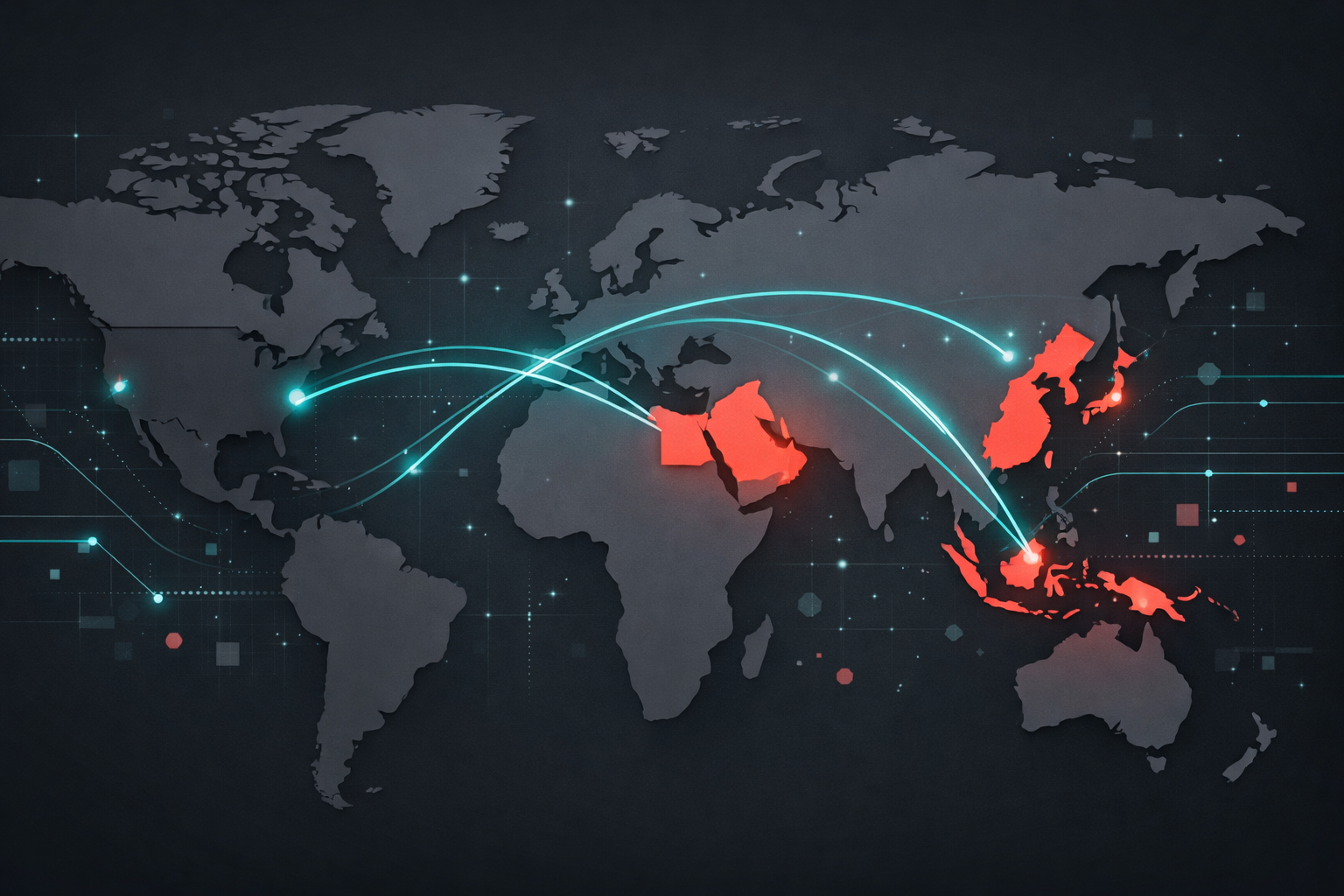
The United States builds the most advanced AI systems on the planet. American companies created ChatGPT, Claude, and Gemini. American data centers power the global AI infrastructure. American researchers publish the most influential papers. By every measure of AI innovation, the US leads the world.

And yet, when it comes to actually using AI, America ranks 24th.

That's the finding from Microsoft's latest AI diffusion report, which tracks what percentage of working-age populations are actively using generative AI tools. The US sits at 28.3% adoption—behind not just tech hubs like Singapore and Norway, but also behind Belgium, the Netherlands, and Spain.

The countries at the top of the leaderboard? The United Arab Emirates at 64% and Singapore at 61%. South Korea made the most dramatic leap of any nation, jumping from 25th to 18th place in just six months.

This gap between innovation and adoption should matter to every association leader reading this. Because history shows that the countries—and organizations—that benefit most from transformative technologies aren't necessarily the ones that invent them. They're the ones that figure out how to use them.

The Innovation-Adoption Paradox

AI is what economists call a general-purpose technology, similar to electricity or the internet. These technologies reshape entire economies, but the benefits don't flow automatically to whoever develops them first. They flow to whoever deploys them most effectively across their workforce, their processes, and their communities.

Consider electricity. The United States and Europe pioneered electrical systems in the late 19th century. But the economic gains from electrification varied enormously based on how quickly and thoroughly different countries wired their factories, homes, and cities. Some nations that weren't at the forefront of electrical innovation nonetheless leapfrogged ahead by adopting the technology faster and more comprehensively.

The same pattern is emerging with AI. The US dominates frontier model development. But when you measure how many people are actually putting these tools to work, America falls far behind smaller, more nimble countries that have made adoption a national priority.

For associations, this distinction matters enormously. Your organization didn't invent AI. Neither did the professions and industries you serve. But your ability to thrive in the coming decade depends heavily on how quickly and effectively you help your members adopt it.

How the UAE Built a 35-Point Trust Advantage

The UAE's position at the top of the adoption rankings didn't happen by accident. It was the result of deliberate, sustained effort that began years before most governments were paying attention to AI at all.

In 2017—five full years before ChatGPT captured the world's attention—the UAE appointed the world's first Minister of State for Artificial Intelligence. The government's first move wasn't building AI systems or funding startups. It was skilling government employees so they could deploy AI in public services.

That sequencing proved consequential. By the time generative AI arrived, UAE residents had already been interacting with AI-powered government services for years. They'd seen AI route ambulances through traffic. They'd experienced AI systems directing patients to hospitals with available beds. The technology wasn't abstract or threatening—it was familiar and useful.

The trust data reflects this head start. According to the 2025 Edelman Trust Barometer, 67% of UAE residents trust AI. In the United States, that number is 32%. That's a 35-point gap—one of the largest cross-national differences in technology attitudes measured anywhere.

Trust, visibility, and government adoption created a reinforcing cycle. People trusted AI because they'd seen it work. They'd seen it work because the government deployed it in visible, practical ways. And the government deployed it because leadership made AI adoption a strategic priority years before their counterparts elsewhere.

South Korea's 80% Surge

If the UAE demonstrates what years of preparation can accomplish, South Korea shows what's possible when a country mobilizes quickly.

In the second half of 2025, South Korea jumped seven positions in the global rankings—the largest gain of any nation. Its AI user base grew more than 80% in that period, far outpacing the global average. South Korea is now OpenAI's second-largest ChatGPT subscriber market, behind only the United States.

Three factors drove this remarkable acceleration.

First, the government moved from strategic vision to concrete action. South Korea established a National AI Strategy Committee, passed the AI Basic Act, and committed nearly $1 billion to AI education spanning elementary school through workplace training. The investment wasn't just in technology—it was in people.

Second, the AI models got dramatically better at Korean. For years, large language models performed poorly in Korean, limiting their practical usefulness for most of the population. But newer models now perform at levels comparable to top university students on Korea's rigorous college entrance exam. When AI works well in the language people actually speak, adoption follows.

Third, a cultural moment opened the door. When Ghibli-style AI-generated images went viral across Korean social platforms in early 2025, millions of people tried generative AI for the first time. What made this different from typical viral trends is that usage stayed high afterward. People who came for the novelty discovered they could use these tools for real tasks—writing, research, creative projects, work.

The combination of policy action, improved language support, and a consumer-friendly entry point created conditions for rapid adoption. South Korea demonstrated that it's possible to move fast when leadership, technology, and cultural readiness align.

Why the US Is Falling Behind

If national AI adoption were determined purely by access to technology, the United States would lead the world. American workers have the infrastructure, the devices, and the proximity to the companies building these tools. So what's holding us back?

Size and decentralization play a role. The UAE can make decisions quickly because power is centralized. South Korea, though democratic, is geographically compact and culturally cohesive. The United States is a sprawling, federated system where policy emerges from countless state governments, federal agencies, and private institutions—none of which are coordinating on AI strategy in any systematic way.

Political polarization compounds the challenge. AI touches on contentious issues—job displacement, privacy, safety, the concentration of power in technology companies. These are legitimate concerns that deserve serious attention. But in a polarized environment, serious attention often translates to gridlock rather than action.

Perhaps most importantly, there's no unified effort to skill the American workforce on AI. Individual companies are training their employees. Some universities are updating their curricula. But there's nothing approaching the national mobilization happening in the UAE, South Korea, or other leading adopters.

The concerns about AI are real. The potential for job disruption, the risks of misuse, the questions about bias and safety—none of these should be dismissed. But avoidance isn't a strategy. The countries racing ahead on adoption aren't ignoring these challenges. They're engaging with them while simultaneously building their populations' capacity to use these tools effectively.

The Association Playbook

What does any of this mean for associations? You're not a national government. You can't pass legislation or redirect billions in public funding. But you have more influence over AI adoption in your sector than you might realize—and the playbook from leading countries translates surprisingly well to organizational strategy.

Start by skilling your own team. The UAE's first move wasn't deploying AI to citizens—it was training government employees. Similarly, your association can't lead AI adoption in your profession if your own staff doesn't understand the technology. Leadership can't make good strategic decisions about AI if they haven't used it themselves. Before you launch member-facing AI initiatives, make sure your internal team has hands-on experience.

Deploy AI in visible, practical ways that build trust. The UAE succeeded partly because people could see AI working in contexts that mattered to them—ambulances routed through traffic faster, patients directed to hospitals with available beds. For associations, this might look like an AI assistant that gives members instant, accurate answers to certification questions that used to require a three-day email exchange. Or an AI tool that analyzes a member's credentials and experience to surface job opportunities they'd actually qualify for—not just keyword matches. Or a system that alerts members when regulatory changes affect their specific practice area, with plain-language explanations of what they need to do differently. When members see AI solving problems they actually have, they're more likely to embrace it in their own work.

Provide training in your profession's language. One reason South Korea's adoption surged is that AI finally worked well in Korean. The parallel for associations is contextualizing AI training for your specific sector. Generic AI courses are widely available. What your members need is guidance on how AI applies to their particular workflows, terminology, and challenges. A nurse, an engineer, and a lawyer all use AI differently. Training that speaks to those differences is far more valuable than one-size-fits-all content.

Recognize that fear follows from ignorance. The absence of knowledge leads to fear. You can't trust something you don't understand. You can't evaluate AI's potential or limitations if you've never used it. The trust gap between the UAE (67%) and the US (32%) reflects, in large part, differences in familiarity. The more your members interact with AI in low-stakes, practical contexts, the better equipped they'll be to make informed decisions about how it fits into their professional lives.

Make adoption a strategic priority now. The UAE started preparing for AI in 2017. South Korea mobilized aggressively in 2025. In both cases, leadership decided that AI capability was a national priority and acted accordingly. Associations face the same choice. You can wait to see how AI develops and respond reactively. Or you can decide that helping your members build AI fluency is a core part of your mission—and invest accordingly.

The Stakes Are Higher Than They Appear

The Microsoft report measures AI adoption as a simple percentage: what share of the working-age population is using generative AI tools? But behind that number lies a more consequential question about economic competitiveness and professional relevance.

Countries that adopt AI faster will see productivity gains sooner. Their workers will develop skills that become increasingly valuable. Their industries will find efficiencies that competitors miss. Over time, adoption gaps can become economic gaps—and those gaps tend to compound.

The same dynamics apply at the professional level. Within any given field, the practitioners who learn to work effectively with AI will have advantages over those who don't. They'll be faster, more capable, and more valuable to employers. Associations exist to help their members succeed professionally. In a world where AI capability increasingly determines professional success, helping members adopt AI isn't optional—it's central to the mission.

The countries leading the AI adoption race share a common thread: they decided that AI fluency was a priority, they invested in skilling their populations, and they built trust through practical deployment. Associations have access to the same levers. The question is whether you'll use them.

Mallory Mejias
Post by Mallory Mejias
January 27, 2026
Mallory Mejias is passionate about creating opportunities for association professionals to learn, grow, and better serve their members using artificial intelligence. She enjoys blending creativity and innovation to produce fresh, meaningful content for the association space. Mallory co-hosts and produces the Sidecar Sync podcast, where she delves into the latest trends in AI and technology, translating them into actionable insights.