If you've been paying attention to AI news over the past year, you already know the feeling. A new model drops and the benchmarks are unprecedented. A startup releases something that makes last month's breakthrough look quaint. A tool you just onboarded announces a major pivot. By the time you've finished reading one analysis, three more developments have landed in your feed.

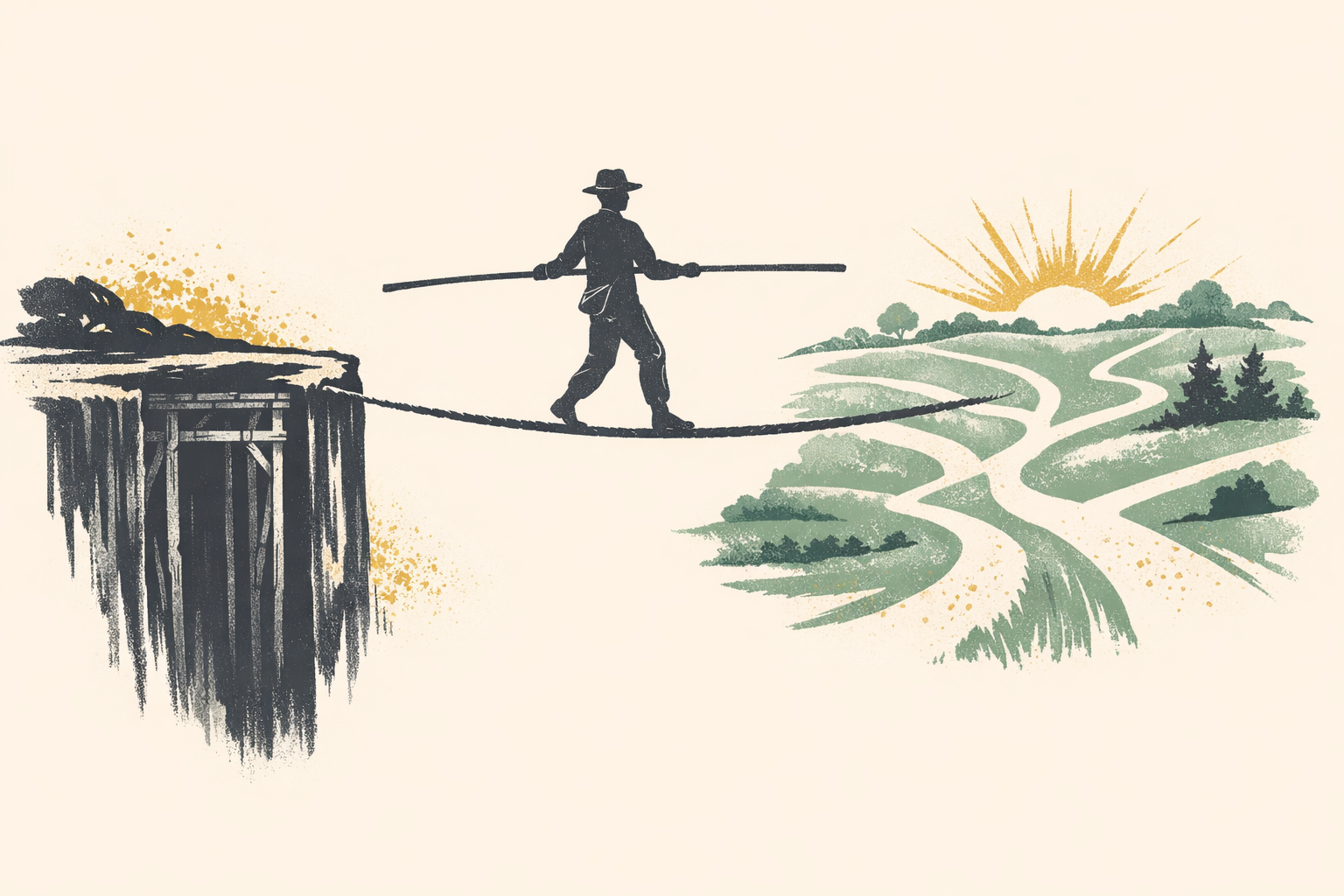
For association leaders trying to build an AI strategy in this environment, the temptation pulls in two directions. One instinct says chase everything — stay current, test every new tool, never fall behind. The other says pick something and commit — block out the noise, go deep, and stop second-guessing. Both instincts make sense. And both, taken to their extreme, will leave your organization worse off.

There's a better way to think about this, and it comes from an unexpected place: a concept in reinforcement learning called the exploration-exploitation trade-off.

What the Exploration-Exploitation Trade-Off Actually Means

Reinforcement learning is a branch of AI where systems learn by making decisions and observing the results. Think of it less like a student studying for an exam and more like someone navigating a city they've never visited. Every choice — turn left, turn right, try this restaurant, skip that street — teaches them something about the environment.

At the core of this process is a tension that never goes away. Do you exploit what you already know works — go back to the restaurant that was great last night — or do you explore something new that might be even better, knowing it could also be worse?

Go too hard on exploitation and you get stuck. You optimize for a local maximum, extracting every bit of value from your current approach, but you miss the possibility that something fundamentally better exists just around the corner. Go too hard on exploration and you never build depth. You sample everything, master nothing, and spend all your energy on context-switching instead of compounding your knowledge.

The best outcomes come from balancing the two — committing deeply enough to extract real value, while staying open enough to recognize when the landscape has shifted.

This isn't just an academic concept. It's the most useful strategic framework available for association leaders trying to figure out how to approach AI right now.

Why Whatever You're Doubling Down On Is Probably Wrong (And Why That's Okay)

AI is the fastest-growing field in human history. Hundreds of research papers are published every day. Hundreds of billions of dollars flow into development annually. Tens of thousands of startups are building products across every conceivable use case. The sheer velocity means that the odds of any single tool, platform, or strategy you commit to today being the optimal choice twelve months from now are genuinely slim.

That might sound discouraging. It shouldn't be. Here's why.

If whatever you're doubling down on is likely to be superseded eventually, then the pressure to pick the "right" thing evaporates. You don't need to find the perfect AI tool. You need to find one that's good enough to deliver real value for your members and your operations right now — and then actually use it long enough to learn something meaningful from the experience.

Because here's the other side of the equation: switching every time something new appears is guaranteed to produce worse outcomes than sticking with an imperfect choice. Every switch resets your learning curve. Every migration eats time, budget, and team energy. Every new tool requires new workflows, new training, new integration points. If you're swapping tools every quarter, you're spending the majority of your time on transitions and almost none of it on the actual work those tools were supposed to enable.

The goal isn't to be right forever. It's to be intentional now, extract as much value as you can, and build in the discipline to reassess at the right intervals.

Think of AI as Your Newest Team Member

One of the most practical ways to internalize this balance is to stop thinking of AI as software and start thinking of it as a new hire.

Specifically, imagine someone who just walked in the door with multiple advanced degrees, enormous raw capability, and absolutely zero understanding of how your organization actually works. They're brilliant. They're eager. They're occasionally confidently wrong in ways that would be embarrassing if you didn't catch them. They don't know your members, your culture, your workflows, or why certain things are done the way they're done.

Now, you wouldn't restructure your entire organization around this person's strengths on their first week. You'd figure out where they fit, what they're good at, and how to communicate with them effectively. You'd invest time in onboarding them — not just showing them the tools, but helping them understand the context that makes your work meaningful.

You also wouldn't fire them every time a recruiter called with someone who had slightly better credentials. A new hire with marginally higher test scores doesn't help you if you have to start the onboarding process from scratch every month.

And you wouldn't build rigid, permanent policies around one specific person's quirks — because people grow, change roles, and sometimes move on. You'd build flexible processes that accommodate the type of contribution this role provides, not the specific individual filling it.

That's the posture associations should take with AI. Invest in learning how to work with it. Build it into your workflows thoughtfully. Don't obsess over having the absolute best model or tool at every moment. And build your processes with enough flexibility that when something better comes along — and it will — you can adapt without starting over.

The 6-12 Month Rhythm

So how does this translate into actual planning? The exploration-exploitation trade-off suggests a rhythm, not a rigid roadmap.

Commit to your current AI tools and use cases in focused intervals — somewhere between six and twelve months, depending on the complexity of what you're implementing. During that window, go deep. Build real competency on your team. Develop workflows that take full advantage of what the tools can do. Measure results against specific goals. Resist the urge to switch every time a headline tells you something newer has arrived.

Then, at the end of that interval, step back. Pop your head up and look around. What's changed in the landscape? Has a new capability emerged that fundamentally shifts what's possible for your members? Has the tool you've been using fallen behind in ways that matter — not in benchmarks that don't affect your work, but in capabilities that directly relate to what you're trying to accomplish?

If your core thesis still holds, keep going deeper. There's almost certainly more value to extract from what you're already using than you've realized. If the ground has genuinely shifted, adjust your approach — and do it without guilt or the feeling that you wasted the last six months. You didn't. The competency your team built, the workflows you developed, the understanding of what AI can and can't do for your organization — all of that carries forward even if the specific tool changes.

The key is having a rhythm that prevents both failure modes: the organization that never commits long enough to learn anything, and the organization that commits so hard it can't see when the world has moved on.

Finding Your Balance

The exploration-exploitation trade-off doesn't give you a formula. It gives you something more valuable: permission to stop trying to get AI perfectly right on the first attempt and instead build a practice of going deep, stepping back, and adjusting.

The associations that struggle most with AI aren't the ones that pick the wrong tool. They're the ones that either jump from tool to tool without ever building real capability, or lock in so tightly that they can't pivot when the technology evolves beneath them. The sweet spot is in between — committed enough to extract genuine value, flexible enough to course-correct when it matters.

That balance isn't something you achieve once. It's something you practice, refine, and get better at over time. Which, if you think about it, is exactly how reinforcement learning works too.

Mallory Mejias
Post by Mallory Mejias
February 18, 2026
Mallory Mejias is passionate about creating opportunities for association professionals to learn, grow, and better serve their members using artificial intelligence. She enjoys blending creativity and innovation to produce fresh, meaningful content for the association space. Mallory co-hosts and produces the Sidecar Sync podcast, where she delves into the latest trends in AI and technology, translating them into actionable insights.