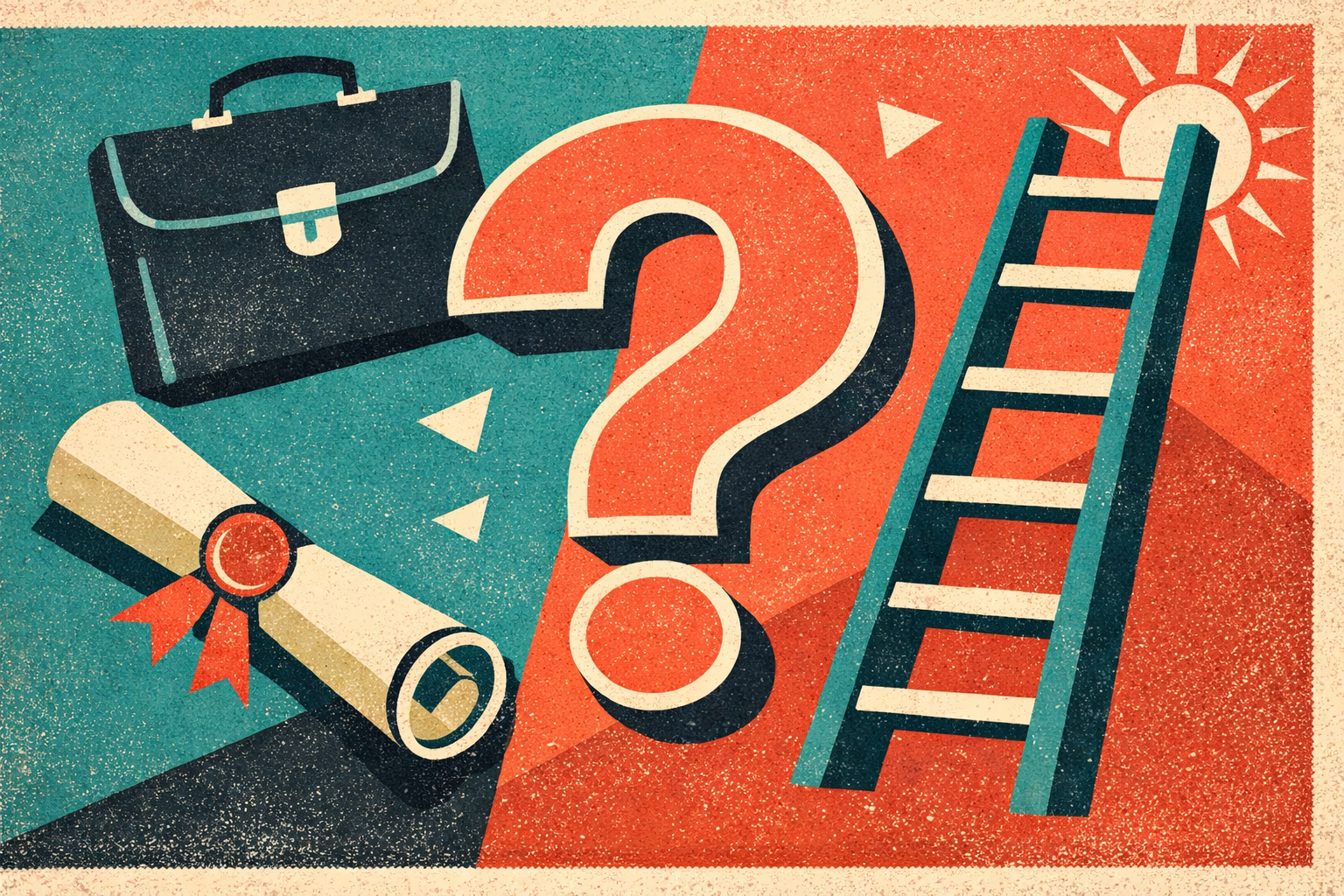
Most conversations about AI and employment follow a familiar script. Jobs will be lost. Workers will need to reskill. Organizations should invest in training programs to help people adapt.

That framing isn't wrong, but it misses something important.

In a recent conversation on the Sidecar Sync Podcast, Bruce Reed—head of AI at Common Sense Media and former deputy chief of staff in the Biden White House—raised a concern that doesn't get nearly enough attention. Work provides more than income. It provides identity, structure, community, and purpose. A job is about a lot more than a paycheck. It's about your place in the community.

If AI disrupts the professions your members have built their lives around, the question won't just be "How do they earn a living?" It will be "How do they find meaning?"

Associations that only focus on upskilling may find themselves solving the wrong problem.

Why This Displacement Is Different

Technology has always changed work. The printing press, the steam engine, the assembly line, the internet—each wave eliminated some jobs while creating others. And historically, the jobs most vulnerable were those requiring less formal education, where displaced workers could find similar employment relatively quickly.

AI flips that pattern.

The professions most exposed to AI disruption are often the ones people spend years and significant money preparing for. Lawyers reviewing documents. Radiologists analyzing scans. Software engineers writing code. Financial analysts building models. These are careers that require advanced degrees, professional certifications, and substantial investments of time and tuition.

AI will make these professionals more productive. A lawyer using AI can review contracts faster. A developer using AI can write code more efficiently. But that productivity gain has a shadow: society may need fewer of these professionals to accomplish the same work.

The credential that took years to earn—the degree, the license, the specialized expertise—may suddenly carry less weight. And unlike a factory worker who loses a job and finds another factory, a displaced professional faces a harder question: What is my training even for now?

The Hidden Cost of Losing Work

When people lose their professional identity, the effects extend far beyond their bank accounts.

Research on long-term unemployment and disability exit consistently shows a troubling pattern. People who leave the workforce and struggle to return often experience declining mental health, social isolation, and increased rates of substance use. 

Work gives us reasons to get up in the morning. It connects us to colleagues and communities. It provides problems to solve, skills to develop, and contributions to make. When that structure disappears, people often struggle to replace it on their own.

The risk with AI-driven displacement is that this struggle could become widespread. Not concentrated in a single industry or region, but distributed across professions and geographies. If everyone has to navigate that loss of purpose individually, without organized support, the social strain will be significant.

Income Replacement Isn't Enough

There's a reasonable argument that society can address job displacement through policy mechanisms. Universal basic income. Expanded social safety nets. Retraining subsidies. These ideas have merit, and some version of income support may become necessary as AI reshapes labor markets.

But income doesn't replace purpose.

You can give someone enough money to pay their bills. You cannot deposit meaning into their bank account. The question "How will people earn?" is important. The question "How will people matter?" may be more important still.

This is where the conversation about AI and work tends to go shallow. Economic analyses focus on wages and employment rates—metrics that matter but don't capture the full picture. What happens to someone's sense of self when the expertise they spent decades developing becomes automated? What happens to professional communities when the shared challenges that bound them together are suddenly solved by machines?

What Associations Have Traditionally Provided

Associations exist to serve professionals. Historically, that service has centered on career advancement: credentials, continuing education, networking, job boards, advocacy for the profession's interests.

That model assumes a relatively stable relationship between professional identity and employment. You become a nurse, join a nursing association, advance in your nursing career, and retire as a nurse. The association supports you along that linear path.

AI may disrupt that linearity. Career paths may become more fragmented. Professional identities may need to evolve or expand. The expertise that defined a profession for decades may become table stakes rather than differentiators.

If associations continue offering the same career-advancement playbook in a world where careers themselves are being redefined, they risk becoming irrelevant precisely when their members need guidance most.

Evolutionary, not Revolutionary

The opportunity for associations isn't to reinvent themselves as purpose organizations. It's to recognize that much of what associations already do serves the purpose function—and to lean into that intentionally.

Mentorship programs, peer communities, volunteer leadership opportunities, annual gatherings that reconnect people with why they entered the field—these aren't just member benefits. They're purpose infrastructure. When a mid-career professional mentors a newcomer, both people walk away with something that transcends skills transfer. When members gather and remember they're part of something larger than their daily grind, that matters.

The question is whether associations are investing enough in those elements—especially as the transactional parts of membership face more competition from AI-powered alternatives. Job boards, technical training, even credentials: these are increasingly commoditized. The parts that can't be replicated by a machine are the human connections, the sense of belonging, the identity that comes from being part of a professional community.

If your members are anxious about career disruption, convening honest conversations about what's changing might matter more than another certification. If longtime members are aging out of active practice, creating meaningful roles for them within the association keeps expertise circulating and gives people a reason to stay engaged.

None of this requires blowing up your strategic plan. It requires paying attention to what members actually need—and noticing that some of those needs may not be on your current survey.

The Human Touch at Scale

Most people don't want to spend their later years talking to Alexa or Siri. They want human connection. They want to feel known, understood, and valued by other humans.

AI can do many things well. It cannot make you feel like you belong. It cannot validate your contribution to something larger than yourself. It cannot sit with you in uncertainty and remind you that you matter.

Those are fundamentally human capacities. And as AI handles more of the transactional elements of professional life—answering questions, processing information, completing routine tasks—the relational elements become more valuable, not less.

Associations have provided human connection at scale for over a century. That capability is now a strategic asset. The organizations that recognize this shift and invest in deepening genuine community will find themselves more essential to members than ever before.

A Different Kind of Leadership

None of this is easy. Associations are already stretched thin, navigating membership declines, budget pressures, and their own AI adoption challenges. Adding "help members find existential meaning" to the strategic plan may feel like overreach.

But consider the alternative. If associations remain narrowly focused on skills and credentials while their members face a crisis of purpose, they'll be offering aspirin for a broken bone. Members will drift away—not because they don't value the association, but because the association isn't addressing what they actually need.

The associations that thrive in the AI era may be those willing to expand their ambition. To see themselves not just as professional development providers but as anchors for identity and community in a time of profound change.

That's a significant shift. It requires different programming, different messaging, and perhaps different metrics of success. But it also represents an opportunity to matter more deeply to members than associations have in decades.

Mallory Mejias
Post by Mallory Mejias
February 3, 2026
Mallory Mejias is passionate about creating opportunities for association professionals to learn, grow, and better serve their members using artificial intelligence. She enjoys blending creativity and innovation to produce fresh, meaningful content for the association space. Mallory co-hosts and produces the Sidecar Sync podcast, where she delves into the latest trends in AI and technology, translating them into actionable insights.