Summary:
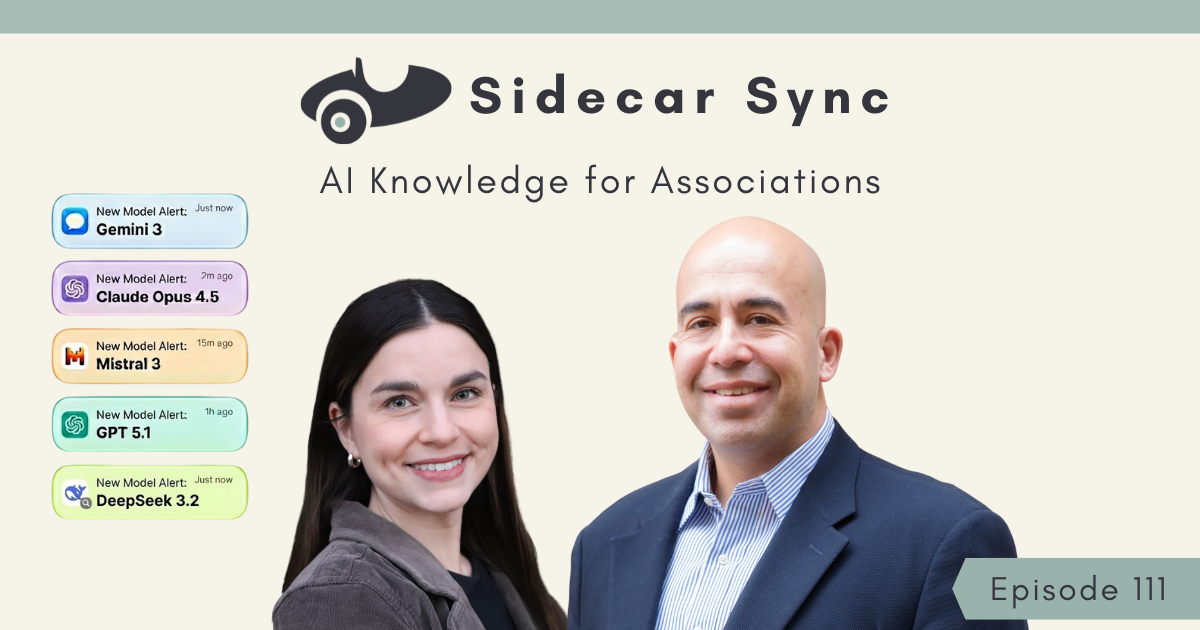
This week on the Sidecar Sync, Mallory Mejias and Amith Nagarajan unpack one of the most explosive weeks in AI so far—from the stunning debut of Google's Gemini 3 to the jaw-dropping image generation of Nano Banana Pro, and the best-in-class coding chops of Claude Opus 4.5. They also dive into Mistral 3 and DeepSeek 3.2, two powerful open-weight alternatives making waves in the AI space. With OpenAI allegedly declaring a Code Red in response, the co-hosts break down what this all means for the future of associations and how to stay agile amid rapid innovation.
Timestamps:
00:00 - Introduction & Scuba Diving Adventures03:03 - DeepSeek 3.2: Fast, Free & Frontier-Level
07:33 - Gemini 3 Launch: Google's New Era
12:09 - Nano Banana Pro: Image Gen Gets Real
15:56 - Image Verification Under Threat
18:37 – Claude Opus 4.5: The Coding Beast
25:13 – Should Associations Hire AI Devs?
28:02 – Mistral 3: Open Source on the Rise
33:41 – Building with Flexibility: Open vs. Closed Models
37:52 – OpenAI's Code Red: Garlic vs. Gemini
43:21 – Lessons for Associations from Big AI Strategy Shifts
46:28 – Final Thoughts: Flexibility Is the Future
👥Provide comprehensive AI education for your team
https://learn.sidecar.ai/teams
📅 Find out more digitalNow 2026:
https://digitalnow.sidecar.ai/digitalnow2026
🤖 Join the AI Mastermind:
https://sidecar.ai/association-ai-mas...
🎀 Use code AIPOD50 for $50 off your Association AI Professional (AAiP) certification
📕 Download ‘Ascend 3rd Edition: Unlocking the Power of AI for Associations’ for FREE
🛠 AI Tools and Resources Mentioned in This Episode:
DeepSeek 3.2 ➔ https://github.com/deepseek-ai
Gemini 3 ➔ https://deepmind.google/technologies/gemini
Claude Opus 4.5 ➔ https://claude.ai
Nano Banana Pro ➔ https://deepmind.google/technologies/gemini#image-generation
Mistral 3 ➔ https://mistral.ai/news/mistral-3
ChatGPT ➔ https://openai.com/chatgpt
https://www.linkedin.com/company/sidecar-global
https://twitter.com/sidecarglobal
https://www.youtube.com/@SidecarSync
⚙️ Other Resources from Sidecar:
- Sidecar Blog
- Sidecar Community
- digitalNow Conference
- Upcoming Webinars and Events
- Association AI Mastermind Group
More about Your Hosts:
Amith Nagarajan is the Chairman of Blue Cypress 🔗 https://BlueCypress.io, a family of purpose-driven companies and proud practitioners of Conscious Capitalism. The Blue Cypress companies focus on helping associations, non-profits, and other purpose-driven organizations achieve long-term success. Amith is also an active early-stage investor in B2B SaaS companies. He’s had the good fortune of nearly three decades of success as an entrepreneur and enjoys helping others in their journey.
📣 Follow Amith on LinkedIn:
https://linkedin.com/amithnagarajan
Mallory Mejias is passionate about creating opportunities for association professionals to learn, grow, and better serve their members using artificial intelligence. She enjoys blending creativity and innovation to produce fresh, meaningful content for the association space.
📣 Follow Mallory on Linkedin:
https://linkedin.com/mallorymejias
Read the Transcript
🤖 Please note this transcript was generated using (you guessed it) AI, so please excuse any errors 🤖
- [00:00:00:14 - 00:00:09:17]
Mallory
Welcome to the Sidecar Sync Podcast, your home for all things innovation, artificial intelligence and associations.
[00:00:09:17 - 00:00:25:12]
Amith
AI and the world of associations. My name is Amith Nagarajan.
[00:00:25:12 - 00:00:27:03]
Mallory
My name is Mallory Mejias.
[00:00:27:03 - 00:00:35:03]
Amith
And we are your hosts. And today, we have a heck of an episode for you. Lots of model releases, lots of craziness going on in the world of AI.
[00:00:36:08 - 00:00:46:16]
Amith
And actually, just before we recorded, a new model came out, which we'll talk about momentarily. It's just a crazy, crazy time. Well, first of all, how you doing, Mallory? It's been an interesting last week or so since we last chatted.
[00:00:46:16 - 00:01:02:02]
Mallory
It has been an interesting last week or so. We are fresh off the Thanksgiving holidays. My husband and I went to Belize. Amit, I told you I got Scuba certified, which was really fun, a little bit scary, but a great way to be outside, be underwater, which I've never done.
[00:01:03:05 - 00:01:16:07]
Mallory
But I will say the AI news didn't stop for the holidays, didn't stop for me because I came back and said, oh my gosh, we've got a good, what, four or five models that we need to jam pack into this episode today. How are your holidays with me?
[00:01:16:07 - 00:01:25:15]
Amith
Seriously, well, perhaps not as exciting as yours because I do love scuba diving. I haven't done it in quite a number of years. I've heard Belize is a great place to visit. I hope you have a lot of fun there. It sounds like you did.
[00:01:26:19 - 00:01:36:03]
Amith
And I'm just curious, being certified to be underwater and dive, was that as exciting as being certified in artificial intelligence by Sidecar?
[00:01:36:03 - 00:01:54:22]
Mallory
So, you know, in a different way, yes. I think the AAIP is intellectually exciting for my mind and my work. And then, you know, the PADI certification is excited for my body and for just trying something that was, I didn't think I'd ever do. So exciting in its own right, Amith, I will say.
[00:01:54:22 - 00:02:00:10]
Amith
And did you try to speak to the dolphins using AI to assist you, like we learned about at Digital Now?
[00:02:00:10 - 00:02:19:15]
Mallory
I didn't try to speak to the dolphins. I did see a couple of sharks, which, you know, I didn't know how I react to that, but I was a lot more calm than I thought. I think seeing them in their environment, also they said they weren't really aggressive, so that helped. But seeing the sharks do their own thing, I can see why Dr. Denise Herzing has such an affinity for dolphins. It's just very fascinating to watch.
[00:02:19:15 - 00:02:51:08]
Amith
So it's a whole new world underwater. It's a crazy, crazy world. And I've had the opportunity to dive in Australia off the Great Barrier Reef and a number of other places. Wow. And it's pretty amazing. Probably my favorite place, actually, to be underwater is the Molokini Crater just outside of Maui. I don't think you can go scuba diving there, but you can go snorkeling. And it's just this incredible, incredible place where you have this array of species and color and the reef itself is majestic. So it's an amazing place to put on the list.
[00:02:53:00 - 00:03:02:18]
Amith
But it's an interesting time with a wide diversity of AI models as well as a wide diversity of underwater species. So we have a lot to talk about.
[00:03:02:18 - 00:03:17:22]
Mallory
We're taking it above ground right now. I mean, we've got a lot to cover in this episode, which I'm excited about. But I did want to give you an opportunity to talk briefly about DeepSeek 3.2 since it was so recent, we didn't include it in this episode. So can you give us a little bit of a rundown?
[00:03:17:22 - 00:04:05:12]
Amith
Yeah. You know, for those of us, for those that listen to us regularly know that Mallory does all the hard work and preps for every episode, puts together a lot of detailed show notes for us to work from. And then I just kind of show up and talk. And so, you know, DeepSeek 3.2, I can tell you a little bit about. I've been reading about it quite a bit for the last 24 or 36 hours. And this is a new model release. I'm not sure why they chose to very modestly call it version 3.2. It could very well have been called DeepSeek 4 or maybe DeepSeek 5 or 6 because it does represent a pretty significant leap forward in capability. There were two big innovations technically that happened. One has to do with what's called the attention mechanism, which is the way transformer architectures work and really that's the fundamental breakthrough that happened in 2017.
[00:04:06:18 - 00:06:03:16]
Amith
And it's a very powerful thing that's part of these modern LLMs, but it's also traditionally very inefficient. And what DeepSeek came up with is a way of doing attention that's far more efficient, particularly for very long contexts. So if you have hundreds of thousands of words, you know, that you're feeding into an LLM, it takes a long time. And they found a way to radically speed it up while not losing quality. In fact, in some ways, it looks like they've been able to increase quality. The other thing they've done is created a scalable reinforcement learning framework as part of their training infrastructure, which is a really powerful thing. All of this is open source. The net net of it though, is that DeepSeek 3.2 in the base model variation is roughly as powerful as GPT-5 and almost comparable to Gemini 3 Pro in many ways. So that's a big headline, right? To have another DeepSeek moment, we might not remember this. We'd have to kind of, you know, really think hard, but it wasn't actually last year or the year before when we had that first DeepSeek moment. It was actually January of 2025, the same year we are still in. And so DeepSeek has done it again. They have an incredible model. It's totally free. It's going to appear on tons of inference platforms all over the place very, very quickly. It already has gone live in a number of places. So when you think DeepSeek, don't just think, oh, Chinese model, I can't run it because it's not secure if it's running on their servers. DeepSeek is an open source model, which means any provider, including the ones that you work with like AWS or Azure or companies like Grok with a Q or Cerebrus, these guys can all run DeepSeek 3.2. And there's many other models we'll be talking about, but DeepSeek is clearly one of the leaders in open source. We now have yet another option that is really very much at the frontier. It's not behind. They actually have a particular edition of DeepSeek 3.2 called Special, which I think they called it that just to have everyone have to say special.
[00:06:03:16 - 00:06:06:08]
Mallory
Wait, is it not just special? How do you know it's special?
[00:06:06:08 - 00:06:20:04]
Amith
No, it's not just special Mallory. It's not just special. It's special. It's got a little E on it. So it's very cool. So I love it. It's got like a little twist to it. It's like a twist of lime or something and you drink. It's cool.
[00:06:21:14 - 00:07:25:23]
Amith
And so DeepSeek 3.2 special is about as good as GPT-5 Pro, which is really extraordinary. So now this is brand new information. Lots of people are independently verifying it, all that stuff, but it is pretty remarkable. Later in the episode, we'll be talking about Mistral 3, which just came out yesterday. And that is an incredible set of models ranging in size from very small to substantial, very close to frontier level performance. But having these options come up is just, it's profound because it's an amazing level of reasoning and the cost is very close to zero already. So I wanted to open up a little bit before we got into the other topics that you already had prepared diligently, but DeepSeek 3.2 is definitely worth noting. It is that trend line we keep talking about here in the Sidecar Sync, that intelligence is becoming abundant. It is becoming less costly and more available. And that means for all of our association listeners, the ways you can apply this intelligence, this reasoning really expand. They've become kind of an exponential opportunity for you in terms of ways you can apply this.
[00:07:27:04 - 00:07:32:00]
Mallory
Amith, I'm going to give you an A plus on doing my job for DeepSeek 3.2. You did a very good job.
[00:07:32:00 - 00:07:32:23]
Amith
Thank you.
[00:07:34:01 - 00:08:37:06]
Mallory
Moving on, we're going to talk about Gemini 3, the long awaited discussion I've wanted to have on the podcast. We're going to be talking about Claude Opus 4.5. We'll be talking about Mistral 3, like Amith just mentioned. And then we're going to talk about OpenAI's reaction to it all and the alleged code red that they just called in on Monday of this week. So diving into Gemini 3, Google released Gemini 3 on November 18 of this year, 2025, calling it a new era of intelligence. This is their third generation flagship model, natively multimodal from the ground up, meaning it was trained on text, code, images and more altogether rather than bolting capabilities on after the fact. Gemini 3 is currently topping the LM Arena Community Leader Board, scoring high on PhD level reasoning benchmarks like humanity's last exam and setting new marks on math and coding benchmarks. Google is pushing vibe coding and agentic coding so the model can autonomously scaffold web apps from natural language prompts and operate tools with fewer human interventions.
[00:08:38:09 - 00:09:52:12]
Mallory
Within the first day, over a million users engaged with Gemini 3 via AI Studio and the API. And Google announced the Gemini app has reached 650 million monthly active users. Reception has been broadly positive. Outlets are calling it well-rounded with some saying Google is "winning the AI race for now." Salesforce CEO Mark Benioff posted that after using chat GPT daily for three years, he spent two hours on Gemini 3 and isn't going back. One component I want to call out is Nano Banana Pro, which is, believe it or not, Gemini, the name of Gemini 3's image generation engine. The fidelity has crossed a concerning threshold, perhaps. There is a post circulating on LinkedIn that you sent me a meet that shows you can now generate fake receipts or even passports in a single prompt. And the math on those receipts is accurate. So it seems image-based verification systems might now be or are now obsolete without digital authentication like cryptographic signatures. So I mean, a lot to unpack there. Gemini 3, I feel like Google has historically struggled to compete with chat GPT on consumer adoption and now it seems like they were waiting on purpose. What are you thinking?
[00:09:52:12 - 00:09:59:12]
Amith
Well, first of all, I love the names we're talking about so far in this episode. Nano Banana Pro and then DeepSeek Special.
[00:10:01:03 - 00:10:03:22]
Amith
It's like AI companies are finally getting a little bit fun, right?
[00:10:03:22 - 00:10:05:22]
Mallory
Come on, Nano Banana, it's a good one.
[00:10:05:22 - 00:11:39:24]
Amith
It's pretty cool. I am really pumped about Gemini 3. So I've gotten so tired of waiting for Gemini 3 that if it hadn't actually come out, I'm somewhat of an auto-regressive next-token predictor myself and I tend to hallucinate at times. So I would just make it up because Gemini 3 is really important. So I'm glad it's actually here so I don't have to do that. But Gemini 3 is everything we thought it would be. The reason that the DeepMind team waited is they wanted to get it right and I think they have done that. Gemini 3 is all the things you mentioned. It's also really fast. So one of the criticisms of GPT-5 at launch and still today is that it's extremely slow, particularly via APIs. If you're building apps on it, it's almost unusable at times for anything that is not like batch-based. So Gemini 3 is running on Google's new latest TPU 7 architecture which is the underlying hardware that is proprietary to Google. That was not really the biggest headline around Gemini 3 but there was a little bit of a nick on the paint job of NVIDIA that week because people realized, "Hold on a second. They have all this world-leading AI and it's really fast." And oh, by the way, Gemini was trained on TPUs, not on GPUs. It was trained on Google hardware, not NVIDIA hardware. And so very interesting. Choice leads to competition improving which leads to diversity of ideas and thoughts which leads to good things for the world and so that's pretty cool. What I would say is that chat GPT's choke hold is, back to your question,
[00:11:41:00 - 00:12:07:23]
Amith
likely to be easing because there are better choices out there. The switching costs like Benioff pointed out, not super high as a consumer. So yes, you have some chat history and stuff like that but not that hard to switch from chat GPT to Gemini or for Gemini to Claude. So I think this is an exciting moment in time. We have three really high-quality companies with great consumer apps between Gemini, Claude, and OpenAI and there's obviously others as well. So that's fundamentally a really good thing.
[00:12:09:11 - 00:12:15:19]
Mallory
I've done some light testing around with image generation on Nano, Banana, and I can't even believe I'm saying that out loud.
[00:12:17:01 - 00:12:32:03]
Mallory
The image generation is incredibly impressive. I would say it's the best out there at this moment. And like I said, I only played with it just a bit but I'm super impressed. Amith, have you played around with image generation or coding on Gemini 3? What have you thought with your test?
[00:12:32:03 - 00:12:50:06]
Amith
Coding yes, image generation no, although the stuff that you shared is really impressive and I've seen a number of other examples that are quite stunning. One question I actually have for you is, I know you've been a long-time mid-journey user, is this going to sway your usage from mid-journey over to Nano, Banana, or do you still like mid-journey for some things?
[00:12:50:06 - 00:13:17:08]
Mallory
No, it's a good question. I haven't used mid-journey in a few months and it's because when chat GBT got so much better with image generation, particularly with spelling words, that was something mid-journey just couldn't nail. So I pretty much abandoned it. I'm like Marc Benioff myself. I haven't gone back though and I'm going to assume they probably improved the spelling. So now I have to compare mid-journey to Gemini. But I don't know. I switch fast. When I find something that I like better, I say, "Well, I'm going to go to that now."
[00:13:17:08 - 00:15:13:09]
Amith
Well, and it's so hard to keep up, but it's also worth noting that the folks in Germany at Black Forest Labs, which are the makers of the Flux models, which are the open source image gen models, just released a new family of models that are also outstanding. I don't know if they're benchmarking quite as high as Nano, Banana, and their name certainly isn't as fun to say. But I do think Google has a lead by far compared to everyone else in Nano, Banana Pro. Some of the things that I've seen people do with it is creating flowcharts, creating really high-quality infographics, things that you would have spent a week of a really focused designer's time putting together. What this means is the ability for us to communicate visually, the cost of that's going down, so there's going to be more of it. Hopefully it won't be a whole bunch of AI slop, which there will be plenty of that. But if we can ad hoc generate really high-quality communications to be able to illustrate ideas and concepts, think about education and the world of associations. Associations in many ways, their number one job is to educate their profession. That varies a little bit, but that's generally a true statement. If you can do this with better and better quality visual aids to illustrate ideas and processes, that becomes interesting. So Nano, Banana Pro takes in text and outputs amazing flowcharts and graphics and sequence diagrams and all these other things. It's not just images in the sense of creative art for marketing or for any other purpose, but it's also other things like this. I find that incredibly interesting. It's ability to replicate real artifacts like the post you referred to that has a fake passport. Other than high school kids who are probably excited about creating fake IDs, I think there's both opportunity there in terms of being able to generate artifacts you might find useful or legitimate. Obviously, the concern side of what happens with people being able to at will generate real-looking documents that are obviously totally fake.
[00:15:14:16 - 00:15:40:12]
Amith
My ultimate thought on this to wrap it all up is that Gemini 3 to me is a moment in time we'll probably remember somewhat like GPT-4. When GPT-4 came out, which was March of 23, that really changed the game in terms of quality. You really weren't going to go back to anything prior to that. It's the same thing with this. This is a leap forward ahead of GPT-5, even ahead of CLOD 4.5, which I love.
[00:15:42:02 - 00:15:55:18]
Amith
It's really an outstanding model. Part of it too is Gemini's ability to have conversations that just feel a lot richer and more natural. That's a large part of what people are commenting online is the interactions you have with it are a lot less robotic feeling.
[00:15:56:21 - 00:16:12:17]
Mallory
Zooming out though a bit on that image-based verification that associations might use maybe for credentials or CE documentation. I'm going to ask you, should they be worried? But it sounds like, yes, they should be. What would you be looking ahead to, Amith, as a potential solution to that?
[00:16:12:17 - 00:16:44:15]
Amith
Well, I think that one of the things that happened over the last few years is people have gotten away from understanding another technology that's really good at verification, which is blockchain. There are blockchain-based credentialing systems that are out there if you want to get really, really good at guaranteeing that something is authentic. That's a technology worth investigating. If you're in a field that's heavily regulated or needs to have absolute guarantee of authenticity, that's one way to do credentials. There's companies that are in the association vertical that are focused on exactly that problem.
[00:16:45:15 - 00:16:46:22]
Amith
But I think outside of that,
[00:16:47:24 - 00:16:57:10]
Amith
in Google's case with their particular tool, they have a hidden – and it's not visible to the human eye, but embedded in the image, there is a watermark that will tell you that it's AI generated.
[00:16:58:11 - 00:17:11:11]
Amith
Of course, you do have to go to Google's API to find out if it's got that watermark. That being said, there's plenty of other image tools that are out there that don't do that. So it's going to be a challenge. It's just this brave new world we're entering into.
[00:17:11:11 - 00:17:17:09]
Mallory
Yep. I think blockchain technology is something worth digging into and spending some time with as it pertains to this.
[00:17:18:16 - 00:18:25:11]
Mallory
Moving to Claude Opus 4.5, which I've been using a lot recently. Anthropic released Claude Opus 4.5 on November 24th right over Thanksgiving week, this year 2025. The final member of the Claude 4.5 family after Sonnet 4.5 in September and then Haiku in October, they are marketing it as the best model in the world for coding, agents, and computer use. Opus 4.5 posts state of the art results on SWE Bench verified at 80.9%, the first model to cross the 80% threshold on that coding benchmark. It also leads on benchmarks for tool and computer control. The model maintains a 200,000 token context window and a 64,000 token output limit and has an extended thinking mode, which we've talked about before, where you can configure higher token budgets for deeper reasoning. Anthropic also highlights alignment. They're calling it their most robustly aligned model with lower rates of unsafe behavior and stronger resistance to prompt injection and jailbreak attempts. There's also some significant price cuts alongside the release, roughly a 67% reduction from Opus 4.1.
[00:18:26:18 - 00:18:43:19]
Mallory
Alongside Opus 4.5, Anthropic expanded access to Claude for Chrome, a browser agent, and Claude for Excel, a spreadsheet agent showcasing how the model handles computer use and productivity tasks. So, Amith, what are your initial thoughts on Claude Opus 4.5? Have you used it yourself yet?
[00:18:43:19 - 00:19:00:08]
Amith
Yes, I use it every day. I've been using it since it came out. Claude and specifically Claude Code is my daily driver. I use Anthropic's Claude app on my phone and I use Claude more than anything else. I do use ChatGPT a little bit. I use Gemini a little bit, but Claude is my daily driver.
[00:19:01:10 - 00:19:12:02]
Amith
It's fantastic. So, Opus 4.5 is everything that you just said. It is definitely a better coding model than anything else on the market that I've experienced. I think Gemini 3 Pro is also outstanding.
[00:19:13:06 - 00:19:21:19]
Amith
Gemini 3, by the way, we didn't cover it in the last segment, but there was something else that they introduced, which is another fun name. They released a product called Antigravity.
[00:19:23:03 - 00:20:56:03]
Amith
Google's Antigravity that they released along with Gemini 3 is a new coding IDE or software development environment. The key to it is it actually has the ability to control the browser. So, it has computer use built in. So, the agent that lives in there, which is Gemini 3, can interact with the Google Chrome browser. The reason that's important is if the browser can be controlled by the agent, then it can do full stack software development, meaning that it can build code and then it can see what's going on in the browser. It can interact with the application it's built and then keep iterating. Now, I have not been successful in being able to get that to actually fully work in Antigravity, even with sample applications, because you run out of tokens very quickly and there doesn't seem to be a way to pay for it. I'd be happy to fork over a couple hundred bucks for a one month subscription to try it out or whatever it is, but there doesn't seem to be a way to do that. The reason I point that out is Cloud Code at the moment doesn't have direct browser use built into it. I am sure that that will be coming very, very soon because Opus 4.5 as well as Haiku and SANA 4.5 are both excellent at browser control. They're both really good computer use agents and there is actually a Google Chrome extension for Cloud you can use to do computer use, just like we've talked about in the past with other products. So, I mentioned that because that kind of completes the loop in terms of being able to build applications and test them. We talk a lot about coding in this podcast Mallory and it's interesting because a lot of associations would traditionally say, "Why are you guys talking about software development and coding so much? We're not a software company, we're an association."
[00:20:57:18 - 00:21:21:13]
Amith
Newsflash, you are a software company because we're all software companies. The reason that's true is both because it's much easier and way less expensive to build software but because in order to solve the problems of the future and to fully leverage AI, you have to weave some bits of custom software around your pillar applications like your CRM and like your financial system.
[00:21:22:13 - 00:22:01:07]
Amith
This connective tissue may seem secondary to you when you think about your IT stack as an association but actually I encourage you to think about it in the opposite way because that's what your members interact with. The little app that you built six years ago with some custom web developer and you spent a bunch of money on that takes in applications for a program or something like that, maybe it's a little bit long in the tooth and the experience isn't super great. Well, rather than putting out an RFP and planning to spend six figures or more and spending six to 12 months building it, maybe you should take a crack at it with AI or get a developer who's really good at using AI to do something for you.
[00:22:02:08 - 00:22:40:04]
Amith
If you have this ability and you understand that the ability to write code is within your wheelhouse now because these tools are so powerful and so available, it changes the game. That boils down to a shift in strategy because now you can create member experiences that are dramatically different than what you could have afforded to or what you even independent of dollars could have been able to do with the time you had available. Coming back to Opus 4.5, it is a step change in functionality even over SANA 4.5 which was very good. I found it to both be smarter at solving complex coding problems like in complex applications and agents. It still is limited.
[00:22:41:04 - 00:23:15:04]
Amith
All of these models including Gemini 3 Pro as well, when they get stuck, they just tend to get stuck. Meaning, you get into a problem area where something's not working and it explores different solutions and then none of them solve the problem. Then it goes back to the first solution and loops back and then it makes the same changes over and over. 4.5 still does some of that but it's much better. The human expert developer still has a role to play in saying, "Well, hold on a second. I'm going to try this other thing over here." Because the creativity in these models in solving problems a little bit more logically is still limited.
[00:23:16:24 - 00:23:47:07]
Amith
I think we're going to see more advancements coming but at the same time, my point would be if you haven't yet tried AI for coding, this is an awesome time to give it a shot. Pick a tool of choice. You can use Cursor, you can use Windsurf, you can use Visual Studio Code. Try the new Antigravity from Google. It's got a cool name. It's fun. See what you can do. You don't have to be a professional developer to check this stuff out. Clod Opus 4.5, I think, really opens the door to solving bigger problems for the average user.
[00:23:48:19 - 00:24:05:10]
Mallory
Yes. It makes me think of me when I was moderating that panel at DigitalNow. I had come up with several openings potentially on how I was going to do it. I didn't end up using this one but I was going to ask the audience that was there, raise your hand if you have the skill level to go out there and create an app.
[00:24:06:22 - 00:24:32:19]
Mallory
Basically software developed, created web app. My thought was that most people weren't going to raise their hands but a few people would and then I was going to tell everyone, "Actually, you should all raise your hands because we all have access to this right now in this moment." Amith, would you go as far to say that every association should have someone on staff or hire someone that is an AI software development expert or become that if they're not?
[00:24:32:19 - 00:24:35:14]
Amith
You should have someone in your...
[00:24:36:22 - 00:26:35:24]
Amith
Someone you have a phone number for in your phone who can do that for you, whether it's an employee or a partner or a contractor. Every association of every size should have someone in their close relationships that can help them with this kind of stuff because it is a different world. I'm not suggesting you throw away core systems that process transactions and handle money and stuff like that. Those systems are complicated. They're super, super mission critical and there's not necessarily a need to replace them but what associations tend to lag is the software that meets the member. The software that meets the staff person tends to be where most of the effort goes and it's interesting because I used to be in the business of selling and implementing association management systems or AMS's. I haven't done that in almost 10 years but for over 20 years I did that and the projects that we did, oftentimes I would say 80 to 90% of the time and the money was spent on the internal implementation, meaning getting the AMS up and running and getting it to serve as staff. Then there was this mad rush at the end with whatever time was left and with a handful of dollars that were left over to build out the website to utilize that new AMS. Every single time it was, "Well, we don't have time for that. We're going to cut this piece or cut that piece from the web project." That's what your members see and that's what they interact with and that's why you have challenges at the same time with limited resources and the traditional narrow constraints of having limitations. You're going from a world of scarcity where software is really expensive and hard to build and now we're flipping the script and all of a sudden software is abundant, meaning it's very low cost, it's very easy to build. It means that you can reevaluate those assumptions. That's really what I think all associations should be thinking about. By the way, I love that question. I think we should be asking every year at Digital Now that question and see what the response looks like. I think over time more and more of those people will have their hands up over time.
[00:26:35:24 - 00:27:10:19]
Mallory
I didn't want to trick you all, but I thought it would be an engaging way to start it. Just have to put that out there. Also, a little bit less sizzle. I know we've got tons of writers that listen to our podcast. The writing with Opus 4.5 is excellent. I'm kicking myself that we didn't have it when we were working on Ascend 3 because I use exclusively Claude pretty much for the blogs that I write for Sidecar to assist me and it is noticeably better. Almost like no tweaks pretty much and it's trained up on my style, Sidecar style. Anyway, I just want to throw that in before we move to Mistral 3, the open weight alternative.
[00:27:12:06 - 00:27:30:18]
Mallory
Mistral released Mistral 3 yesterday, December 2nd as of the recording of this podcast. Today is December 3rd as a family of open weight models. It includes Mistral Large 3, the flagship frontier model, plus a suite of smaller mini stroll 3 models aimed at edge devices like laptops, phones, and even drones.
[00:27:32:00 - 00:27:45:11]
Mallory
Mistral Large 3 is a mixture of experts model with 41 billion active parameters and 675 billion total parameters. It's multimodal, text and vision, and optimized for multilingual performance beyond just English.
[00:27:46:13 - 00:27:56:16]
Mallory
The mini stroll 3 line includes 3 billion, 8 billion, and 14 billion parameter models, each offered in base, instruct, and reasoning variants with image understanding.
[00:27:57:18 - 00:28:40:22]
Mallory
These are designed to run on a single GPU or consumer devices. The 3 billion parameter model can even run on a browser. All models are free for commercial use, modification, and redistribution. Mistral is explicitly positioning this as the open weight alternative to closed frontier systems from OpenAI, Google, and Anthropic. For organizations that want strong performance but insist on self-hosted or hybrid deployments where data never leaves their environment. So, Amith, we've covered some highly impressive closed models earlier in this episode, but then we did talk about DeepSeek 3.2 as well, which is another open model. What are the key considerations for our listeners thinking open, closed, coding, images, all the things?
[00:28:40:22 - 00:29:23:22]
Amith
I think that there's two things to think about. One is choice is good, and don't box yourself in. We've talked about the decision frameworks you use to think about your AI roadmap, the way you think about your AI strategy. You want choice. There is no path where you can really guarantee one particular vendor is going to be the winner. If you had asked most people about, at the beginning of the year, if you asked them the question, "Who's the leading frontier lab for AI development?" A lot of people would have just almost reflexively said OpenAI. Then OpenAI released GPT-5, and a lot of people actually after that said, "Oh, it's going to be Google." No one would have guessed Google 18 months prior,
[00:29:25:01 - 00:29:40:13]
Amith
because Google was in the doghouse, and partly for good reason, because they had miffed on the commercialization of the transformer architecture and all that. They've done a really good job in pivoting a beast of a company into quickly going after this opportunity, and they're executing brilliantly now.
[00:29:41:13 - 00:30:05:12]
Amith
Choice is good, because if you were completely locked into OpenAI's ecosystem, let's say that you had built with their agent framework on their cloud, with all of their tooling, and you had written all of your stuff to be specifically like with all the peculiarities of their proprietary APIs, not just the generic model layer, you would not be able to take advantage of Gemini, or in this case, Mistral.
[00:30:06:19 - 00:30:36:21]
Amith
Mistral is an interesting company. They're a Paris-based lab, some brilliant people working over there. Paris actually has a really booming AI scene, and the government of France has done a good job to try to encourage software development and AI specifically to blossom there. I think the Mistral 3 series of models is really interesting, because you go from very, very small on-device and super fast inference, which these ... I mean, the 3 billion model is not only really tiny and can run in a browser, as you mentioned, Mallory, it's actually really smart.
[00:30:37:21 - 00:31:12:20]
Amith
It's about as good as the LAMA 3.3 70 billion parameter model from a year and a half ago-ish. I think that was actually not even a year and a half ago, more like a year and two months ago. That's when Meta and the LAMA models were actually the leading open source models. A lot has changed since then, which again means choice is good and optionality is good. The point is that LAMA 3.3 70 billion parameter model, the Mistral 3 billion parameter model is roughly comparable to that. It's 1.20th the size, roughly a little bit smaller than that. Pretty incredible.
[00:31:14:00 - 00:31:41:22]
Amith
Choice is good. When you think about your AI infrastructure, I'm not talking about if you use chat, GPT, or Claude. I'm talking about what you build your association's systems on top of. Just make sure that you are being very intentional about having flexibility. You want to be able to plug in models from different providers, and in some cases, you might use Mistral for certain things, the Gemini for other things, other vendors for other stuff.
[00:31:43:02 - 00:32:13:23]
Amith
Mistral is just another exclamation point on the necessity to have that optionality in your thinking. We've written a lot about this in the Ascend book. We talk about this in all of our training on the Sidecar AI Learning Hub. We talk about this. It's really important. It's more important than the specific model you use right now because what I can guarantee you is the model you use today will not be the model you use a year from now. It'll be something else. If you are still using the same model a year from now, that's a problem because it's totally out of date by then.
[00:32:15:02 - 00:32:25:04]
Mallory
When you say build-in optionality and flexibility, to me, I feel like what you're saying is lean on open source models for a lot of the development work that you're doing. Is that what you're saying?
[00:32:25:04 - 00:33:18:02]
Amith
Not necessarily. Actually, I think proprietary models in some cases can give you an advantage. It just depends on what you're cooking up. I'll give you an example. Skip, which is our AI agent that does analytics, is a mixture. We utilize open source models. Actually, we use some open AI models. There's a series of models that were released in August called the GPT-OSS models. They have a 120B and a 20B version. I like Speciale much better than that. That's a cooler name. And OpenAno. The 120B version of GPT-OSS is quite good. We use that for a lot of what Skip does. But we also use a little bit of Clod. We're using a little bit of Gemini in some areas as well. We use a mixture, some proprietary and some open source. If you architect your systems infrastructure to allow you to plug in whichever model you want from whichever provider,
[00:33:19:08 - 00:33:31:04]
Amith
and there's ways to do that. There's actually many ways to do that. One way to do it is to make sure that you build on top of a framework that's not provided by the model provider. If you use OpenAI's agent framework, which has its advantages,
[00:33:32:06 - 00:33:34:19]
Amith
but you will always be using only OpenAI models.
[00:33:35:24 - 00:34:08:12]
Amith
That's a key thing that you have to understand is when you look up and down the stack, so to speak, if you go with a model provider for your agent framework, then you're stuck with just that provider's models. Maybe you choose to do that. Maybe you say, "You know what? I'm going to get married to Sam Altman and the OpenAI crew and where they go, I will go and I'm comfortable with that." That's great. But if you add advantages to that, you have less work to do because it's all fully integrated, vertical stack, and you're done. The downside is you can't use Gemini. You can't use Mistral. You can't use DeepSeek. You can't use any other cool stuff that's out there.
[00:34:10:06 - 00:34:46:02]
Amith
There's lots of choices. There's frameworks out there like LangChain and LangGraph, CrewAI, AG2, AutoGen, and also our own Member Junction open source AI data platform for association specifically that all have what are called abstraction layers. These layers of software essentially insulate you from changes to the model. All of our stuff, all of our applications from Betty to Skip to Izzy, all these other products we talk about, none of them directly talk to the models. They all go through essentially this handshake layer, which basically is where we have the ability to swap out models easily. That's what I'm referring to more specifically, Mallory.
[00:34:46:02 - 00:34:54:16]
Mallory
Yeah. I think that makes a ton of sense. You're using some of the more frontier, larger, close models for the most complicated tasks? Is that so?
[00:34:54:16 - 00:35:01:21]
Amith
Yeah. We sip them like fine wine and then we chug the water of open source land a lot more because it's free and cheap or very close to free.
[00:35:03:00 - 00:35:23:22]
Amith
Yeah. Mistral is definitely something we're going to evaluate. I have not personally looked at it yet. The Mistral large model with 41 billion active parameters could be very attractive because that's actually a fairly lightweight model in terms of its runtime requirements. It probably could run on some fairly light hardware. You'll probably see it appear on a lot of the fast inference providers.
[00:35:25:18 - 00:36:11:11]
Amith
Mistral has done a lot of work with not only domain specific for particular industries models, but also the idea of national AIs where you have AIs domiciled in different countries that are trained for those countries. They've done a lot of work in other languages. If your association is very international in scope, Mistral might be a really interesting thing to look at, both because of their philosophy as a company, but also what their tech can do. The only criticism I have is these guys are French. They're from Paris and their model names are just as lame as all of the nerds like me in America who can't come up with creative stuff. Kudos again to the deep seat guys for their special model. I would have liked for Mistral large to have been Mistral Magnifique or something like that. That would have been cool.
[00:36:11:11 - 00:36:19:16]
Mallory
Mistral Baguette. I'm going to laugh so hard at me when we find out that it's actually just deep seek special and not special. I'm going to believe you for now, but that would bring me a lot of joy.
[00:36:19:16 - 00:36:25:22]
Amith
Look, I could be wrong about that and maybe that's a good hallucination, but it's been a lot of fun ever since I read that or thought that I read that.
[00:36:25:22 - 00:36:34:07]
Mallory
Yes. Well, speaking of lame model names, we've got to talk about OpenAI. We've kind of danced around OpenAI this entire episode.
[00:36:35:09 - 00:38:20:08]
Mallory
Let's see how they fit into this whole conversation. On November 12th, they released, wait for it, GPT 5.1, incremental upgrade to GPT 5 with adaptive reasoning that dynamically adjusts compute based on query complexity plus some tone improvements to address complaints that GPT 5 felt stiff and clinical. It's an update, but not a leapfrog moment. So then five days after that, we see Gemini 3 drop and start topping benchmarks and then Opus 4.5 a week after that. So GPT 5.1 was looking like yesterday's news pretty much in a few hours behind the scenes. This is where the drama comes in. OpenAI apparently is now treating Gemini 3 as a serious competitive threat. Experts are saying that Sam Altman issued a company-wide Code Red memo on Monday of this week, explicitly naming Gemini 3 as the catalyst. The directive, focus on improving chat GPT quality and reliability and pause secondary initiatives. According to the information and news outlet that we love to read, OpenAI's chief research officer Mark Chen told colleagues about a new model, codenamed garlic. I like that one. It's performing well on internal evaluations against Gemini 3 and Opus 4.5 in coding and reasoning tasks. An interesting technical detail, Chen reportedly said garlic incorporates pre-training improvements. They can now infuse a smaller model with the same knowledge that previously required a much larger model. That's significant because it suggests they've solved some of the scaling challenges that made GPT 4.5 underwhelming back in February, a model that was essentially phased out within a few months. So Amith, a Code Red at OpenAI, the company that's been the default choice for many organizations, what do you think this tells us about competition?
[00:38:20:08 - 00:41:04:21]
Amith
Well this ties into everything we've talked about, right? Optionality, the ability for one lab to maintain a lead for a moment in time, it's a flash in the pan, it's billions of dollars of development, and then bam, your lead is gone. And Gemini is the real deal. The thing though that we need to remember is that AI has distributed as quickly as it has because it sits on top of the shoulders of the prior generations of exponential growth we've had of the internet, of mobile, of bandwidth. And the king of the internet still to a large extent is Google. Google has more billion plus user systems in the world than anyone else. They have YouTube, they have Gmail, they have obviously search, they have a bunch of distribution. And so distribution plus branding wins and Google's brand is on the rise and they have unbelievable distribution. They have the ability to put Gemini everywhere where these people are and by virtue of being there, Google will likely have a major element of market share. Now if they have a subpar product, then people will make the leap and move over to something else be it Claude or chat GPT. But if Google has the best AI and they weave it in beautifully into the experiences you already know and love, there's a lot of people out there who aren't going to leave. They're just going to stick with Google. So it's the incumbent, the 800 pound gorilla, the 8,000 pound gorilla really that is coming at OpenAI and they're right to take it seriously. I think they need to take Anthropic very seriously on the coding front because Anthropic is hyper-focused on code. There's a lot more you can do with Claude obviously. As you mentioned Mallory, it's an amazing writing tool. It's useful for so much but it is definitely the company that has taken a focus on coding. Gemini and of course notebook LM was an amazing tool, still is an amazing tool. Nano Banana, there's different areas where companies are hyper-focusing in these ways and OpenAI is trying to do everything. They're trying to boil the ocean. They're trying to be the best lab, the best model provider, the best consumer app for chat. They're trying to have the best image models. They're trying to do audio. They're trying to get into hardware. They had this multi-billion dollar deal to acquire Johnny Ive, the maker originally of many of Apple's hit products who's now on board and working for years and creating a consumer device at OpenAI which they have to my knowledge no prior expertise in. They're interested in robotics which is actually what they started with years ago. I think narrowing the lens right now is appropriate. I think that calling code red or saying, "Hey, we're really in this thing," makes sense. I would have thought that they would have said that a while ago, but it's not surprising that Gemini 3 is as good as it is. For them to have waited for the market to react like this, it's kind of weird honestly.
[00:41:06:02 - 00:41:26:18]
Amith
I think that they're in trouble. I think that OpenAI is going to have a really, really hard time. They've made enormous financial commitments based on the assumption that they are the king of the hill and that they are going to capture the lion's share of the economics that will be benefiting the industry as a whole over the next three, four years. They haven't figured out how they're going to make money yet. They're just burning money.
[00:41:28:10 - 00:41:54:23]
Amith
They've got a challenge. At the same time, they've got some brilliant people over there. They have a lot of resources at their disposal. I think if they do focus on chat GPT and the model advancement, they'll absolutely be one of the leading contenders in this space, but they've got some competition right there and they're not necessarily in the lead. In fact, in some ways, they haven't been in the lead in certain categories for a long, long time. Gemini 3 is hitting them where it hurts in their core application of chat GPT.
[00:41:57:05 - 00:42:19:09]
Mallory
Ameth, I like to watch reality TV sometimes. It's my guilty pleasure. I feel like this is a reality TV show heating up, all the major players coming in and Gemini 3 swooping the ground underneath OpenAI. You already answered this, but I want to get your take as it pertains to association. It sounds like you think OpenAI is right to focus in all of its resources, time, effort, energy on chat GPT.
[00:42:20:10 - 00:42:29:18]
Mallory
Do you think there's anything associations can learn from that in terms of focusing all in on one thing, but also still trying to innovate and try new things at the same time?
[00:42:29:18 - 00:42:58:09]
Amith
Sure. They're not literally turning off all of their other projects, but they're taking a much larger percentage of their overall resourcing and pouring it into chat GPT. That isn't necessarily ... Throwing more people at something doesn't necessarily solve the problem faster or better. Sometimes it actually has the opposite effect, but being highly diffused and having tons of different people pursuing different things and actually sometimes multiple groups pursuing the same thing, they're somewhat competitive with each other. That happens in organizations sometimes.
[00:42:59:15 - 00:45:00:21]
Amith
That's problematic. Associations do have that happen to them. Associations a lot of times are committee driven. They like to form and achieve consensus amongst committee members, whether they're staff committees or committees that are composed of volunteers and staff. It takes a long time to get to consensus if you ever do. A result of that is there's lots of appendages. There's all these programs and products and things that associations do that often are some individual on a committee's pet thing where they don't want to let that thing go even though it doesn't make any money or it doesn't serve that many people. Clearing out, doing spring cleaning and focusing on an arrow or set of things absolutely is a lesson we can all learn from in the context of our associations and how we focus our limited resources and limited attention. I think actually Google did a great job of this two years ago. Google declared a Code Red, so it's quite ironic and fun to watch that Altman now is declaring Code Red for OpenAI when they essentially caused the Code Red at Google, but good on them for recognizing it. What Google did is, Sundar Pichai, the CEO of Google of Alphabet said, "Hey, this is a big problem. We're going to address it. We're going to throw all our resources at it." His first move was, or it's amongst his first move, first move that I'm aware of, was to point Demis Asabas, who was the longtime CEO and one of the founders of DeepMind, to lead their overall AI effort. Prior to that, actually, Google had two internal AI labs, Google Brain and DeepMind. They were completely separate organizations. Google Brain was more product focused and DeepMind was much more long-term, long horizon research focused. Frankly, there was a competition that happened there. Ultimately, they chose to put DeepMind in charge and gave them all the resources, all the compute, all the people, and it's paid off in an era or scope too. DeepMind's still pursuing some amazing, big, long-term, long horizon projects, but they're putting a lot of their weight behind Gemini, which is why you see what you see with Gemini and why Sam Altman and company are a little bit freaked out right now.
[00:45:02:00 - 00:45:10:03]
Mallory
Well, Amith, we're wrapping up this long, crazy episode. I'm wondering if you have a few final words associations need to fill in the blank.
[00:45:11:05 - 00:47:13:08]
Amith
Need to go and try this stuff out and need to go have fun with it because ultimately, what's happening here is remarkable. We're watching history take shape in front of our eyes and we want to be part of it. We don't want to be bystanders. So if you're using the same tool in the same way that you used a year ago or two years ago when you first started experimenting with this, don't assume that you're up to speed and you've got the AI checkbox checked because there is no such thing. Every day I wake up and I'm trying to think of new things. My favorite takeaway that I like to leave audiences with when I speak on AI at conferences is very simple. People are overwhelmed by this. And if you're not overwhelmed, you should be. So you shouldn't declare that you've reached the top of Mount AI as you have not. No one has. But what you should do is allocate time for yourself every day to learn something new. Right. And that doesn't mean do your work using AI. It means 15 minutes a day, 30 minutes a day, some amount of time. I like to tell people 15 minutes a day because it's very achievable for anyone. Seven days a week, 365 days a year. Every day of your life, spend 15 minutes doing something new. And on the weekends, if you don't want to do work stuff, go experiment with music AI or do something with artistic or whatever. But if you turn your brain on every day, you are going to advance yourself and you're going to force yourself by doing something different, something new. It could be experimenting with a tool. It could be listening to a podcast to learn some new idea. It could be reading a book. It could be whatever you want. But if you carve out that time, you will find yourself in a good place over time. So the other thing I would just reinforce, I've said it, you know, ad nauseam in this episode, and I say this all the time, give yourself flexibility. Don't bind yourself closely with any particular model. Don't fall in love with Gemini 3 just because the greatest thing right now and then build all your infrastructure that's closely coupled with just Google. Give yourself the ability to switch from model to model and from provider to provider because you can do that. It's not hard to do that. It just requires a tiny bit of thinking to make sure that you have that optionality.
[00:47:14:18 - 00:47:36:16]
Mallory
Well, everybody, you heard it. We saw Google reclaim benchmark leadership with Gemini 3 and Tropic Counter with Opus 4.5 and its coding focus, Mistral and DeepSeek offering credible open-weight alternatives and then OpenAI scrambling internally to respond. The practical reality, as you said, Amith, is no single vendor has a durable lead and organizations that build flexibility
[00:47:36:16 - 00:47:42:05]
(Music Playing)
[00:47:52:23 - 00:48:09:22]
Mallory
Thanks for tuning into the Sidecar Sync podcast. If you want to dive deeper into anything mentioned in this episode, please check out the links in our show notes. And if you're looking for more in-depth AI education for you, your entire team, or your members, head to sidecar.ai.
[00:48:09:22 - 00:48:13:03]
(Music Playing)
December 8, 2025