A post has been circulating on LinkedIn that should make every association leader uncomfortable.
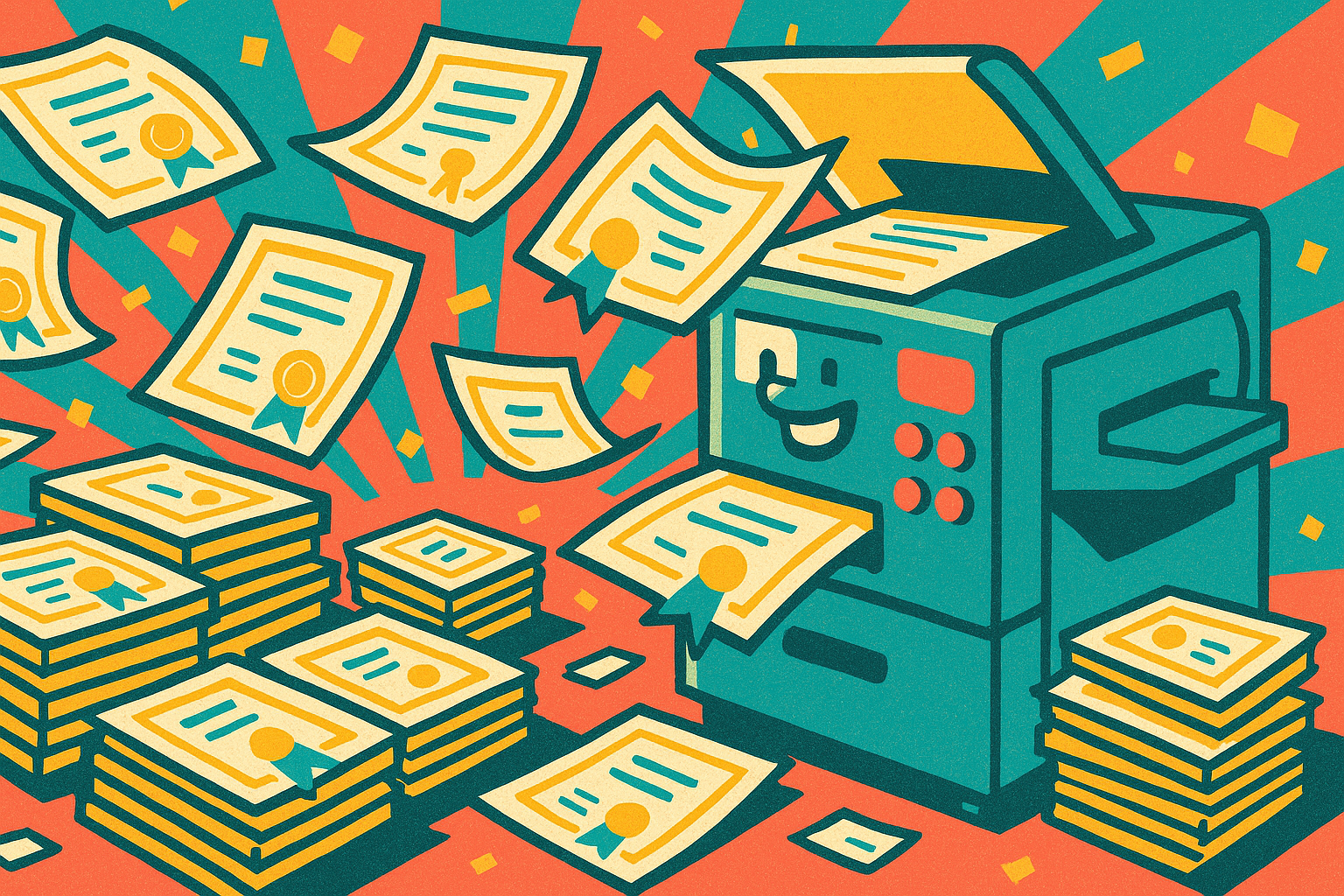
It shows what's now possible with AI image generation: fake receipts where the math actually adds up, fake passports with convincing details, official-looking documents of all kinds—all created from a single text prompt in seconds.
This isn't Photoshop work requiring hours of skilled effort. This is someone typing a sentence and getting back a document that looks legitimate enough to fool most verification processes.
The capability comes from Google's Gemini 3, which includes an image generation engine called Nano Banana Pro. (Yes, that's the actual name.) The fidelity has crossed a threshold that matters. These outputs aren't just visually impressive—they're functional fakes. The details are accurate. The formatting is correct. The overall impression is authenticity.
For associations that issue credentials, certificates, or any form of documentation that members use to prove their qualifications, this is a problem that just became urgent.
What's Actually Possible Now
AI image generation has existed for a few years, but earlier versions struggled with details. Text came out garbled. Numbers didn't make sense. Documents looked obviously artificial if you examined them closely. Those limitations provided a natural barrier against forgery.
That barrier is gone.
Current image generation tools can produce documents where the text is crisp and accurate, where numbers add up correctly, where formatting matches what you'd expect from legitimate sources. Receipts with line items that total properly. Certificates with appropriate seals and signatures. Credentials with the right fonts, layouts, and visual elements.
The speed is part of what makes this different. Creating a convincing fake document used to require either significant technical skill or enough time to manually construct something believable. Now it takes seconds. Someone with no design background and no specialized software can generate a professional-looking credential before their coffee gets cold.
The accessibility matters too. Gemini is available to anyone with a Google account. The barrier to creating fake documents hasn't just lowered—it has effectively collapsed. What was once the domain of sophisticated bad actors is now available to anyone curious enough to try.
Where Associations Are Exposed
Most associations have verification processes that rely, at some level, on visual inspection of documents. That reliance is now a vulnerability.
Consider credential verification. Your certification program issues certificates—PDF documents, digital badges, printed credentials that members can display or share. When an employer wants to verify that someone holds your certification, what happens? Often, the member provides a copy of their certificate. Someone looks at it, confirms it appears legitimate, and moves on.
That process assumed fake certificates were difficult to produce. They're not anymore.
Continuing education documentation presents similar challenges. Members submit proof of CE credits to maintain their certifications. They upload certificates from conferences, training programs, webinars. How do you verify that a certificate from an external provider is genuine and not something generated in thirty seconds?
Membership cards, access credentials, proof-of-status documents—any verification that depends on "does this look real?" is compromised. The question associations need to ask themselves is uncomfortable but necessary: How many of your verification processes would catch a well-generated fake?
For many organizations, the honest answer is not many.
The Watermark Problem
Google anticipated some of this concern. Gemini embeds an invisible watermark in every AI-generated image. The watermark isn't visible to the human eye, but it can be detected through Google's API. If you suspect an image was generated by Gemini, you can check.
This helps, but it doesn't solve the problem.
First, you have to know to check. Most verification workflows aren't set up to run every submitted document through an AI detection API. That would require building new processes, integrating new tools, training staff on when and how to verify. Possible, but not trivial.
Second, you have to use Google's specific tool. The watermark is proprietary to Gemini. There's no universal standard for AI image detection that works across all generators.
Third—and this is the bigger issue—other image generation tools don't include watermarks at all. A fake credential generated through a different AI system has no embedded indicator that it's artificial. It's just an image. You can't detect what isn't there.
The watermark approach assumes a controlled environment where all AI-generated images are marked and all verification systems check for marks. That's not the world we live in. Any solution that depends on bad actors using only watermarked tools isn't really a solution.
Blockchain as a Verification Layer
There's a technology that actually addresses this problem, and it's been available for years: blockchain-based credentialing.
The concept is straightforward. Instead of the credential being the document itself—the PDF, the badge image, the certificate—the credential becomes an entry in a distributed ledger that your organization controls. The document is just a representation. The actual proof lives in the blockchain record.
When someone claims to hold your certification, verification doesn't involve looking at their certificate. It involves checking whether their credential exists in your ledger. Did your organization actually issue this certification to this person on this date? The blockchain answers that question definitively, regardless of what documents the person can produce.
This flips the verification model. You're no longer asking "does this document look legitimate?" You're asking "does our system confirm this credential exists?" The first question can be fooled by a good fake. The second cannot.
For associations in heavily regulated fields, or where the credentials you issue carry significant professional weight, blockchain verification may be worth serious consideration. The cost of a forgery scandal—reputational damage, regulatory scrutiny, erosion of trust in your credentials—likely exceeds the cost of implementing a more robust system.
Practical Steps for Right Now
Not every association will be ready to adopt blockchain credentialing immediately. But every association can start taking steps to reduce their exposure to document forgery.
Audit your verification touchpoints. Map out everywhere your organization relies on visual inspection of documents. Credential verification, CE submissions, membership proof, event access, scholarship applications—anywhere someone submits a document and someone else decides whether it looks legitimate. Those are your vulnerability points. You can't address risks you haven't identified.
Add verification layers that don't depend on documents. Can members verify their credentials through your website using a unique ID or login? Can employers or licensing bodies check directly with your organization rather than relying on a document the member provides? The more you can shift verification away from "look at this document" and toward "check with the source," the less exposed you are.
Consider what third parties need from you. Employers, licensing boards, partner organizations—these entities often need to verify your credentials. What do you offer them? If the answer is "they can look at the certificate the member shows them," that's not enough anymore. Direct verification portals, API access for high-volume verifiers, or blockchain-based solutions give third parties a way to confirm credentials without trusting documents.
Evaluate blockchain options before you need them. If credential integrity is central to your value proposition—if your members' careers depend on the credibility of what you issue—start exploring blockchain-based solutions now. Implementation takes time. You don't want your first serious conversation about blockchain credentialing to happen after a forgery incident forces your hand.
Communicate with your members. Your members may not realize how easy document forgery has become. Some education helps set expectations about why verification processes may need to evolve and why your organization is taking steps to protect the credentials they've worked hard to earn.
The Trust Infrastructure
Associations exist, in part, to create trust. Trust that someone who holds your certification actually earned it. Trust that your credential means something in the marketplace. Trust that when an employer sees your designation after someone's name, it represents real qualifications.
That trust infrastructure is under threat in a way it wasn't a few years ago. The technology to create convincing fakes is now accessible to anyone. Image-based verification is no longer reliable.
The associations that move first to address this will differentiate themselves. They'll be able to say, credibly, that their credentials are tamper-proof. That verification is definitive, not just visual. That the certifications they issue carry weight because they've invested in protecting their integrity.
This isn't a problem for next year's strategic plan. The capability exists today. The question is whether your verification processes are ready for it.
December 10, 2025